
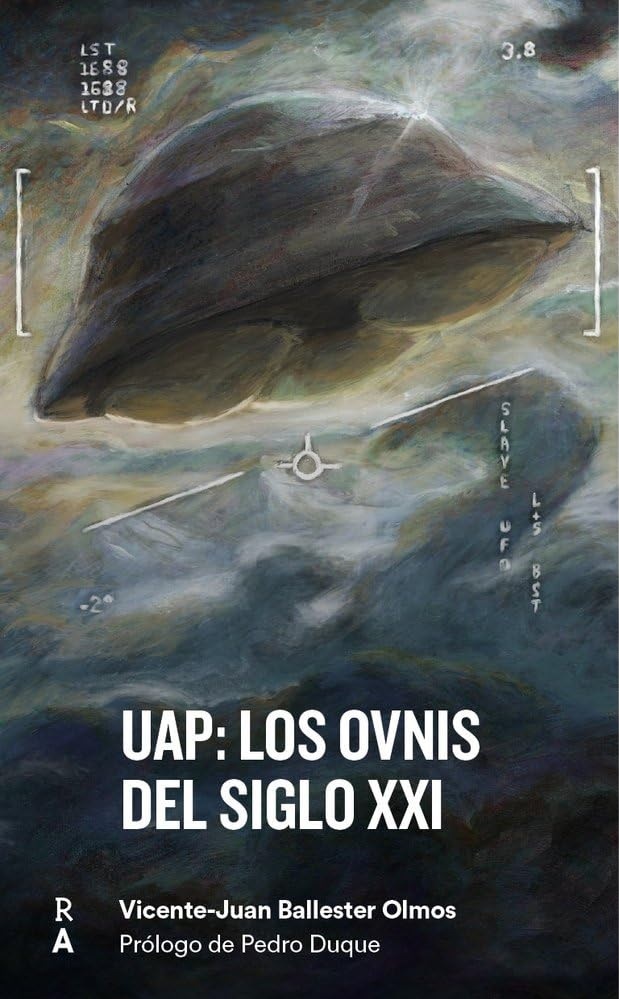
To speak of Vicente-Juan Ballester Olmos is to refer to a school of ufology that seems to be in danger of extinction: that of rigorous archiving, cross-referencing of data and systematic resistance to unbridled fantasy. With sixty years of uninterrupted research behind him, 17 published books and a monumental bibliographic database (more than 600 bibliographic references), and an unavoidable career, his signature is synonymous with a clinical method.
In this volume, Vicente-Juan delivers a work that functions simultaneously as a compendium of maturity, historical balance and methodological manifesto. The text offers an overview of the evolution of the phenomenon of unidentified flying objects, moving from the investigation of field cases and the declassification of government documents to the sociological and psychological deconstruction of the myth.
Ballester frames his work not from mercantilist sensationalism, but from academic rigor and the honest search for the truth. He openly acknowledges how his own perspective evolved from a teenager fascination with "flying saucers" in the 1960s to empirical evidence to support the extraterrestrial hypothesis.
An X-ray Scan of the Modern Phenomenon: From Washington to the Spanish Archives
The central body of the book excellently balances the geopolitics of the "UAP" and the microhistory of the specific case. The analytical structure of the work unfolds as follows:
The book begins with an analysis of the institutional and research dimension in the United States. Ballester Olmos makes a chronological reconstruction that connects the birth of the modern phenomenon after the sighting of Kenneth Arnold in 1947 with current terminology (UAP = Unidentified Anomalous Phenomena). It critically analyzes Pentagon programs—from AAWSP, BAASS, and AATIP to the creation of the AARO office—exposing the contrast between official scrutiny of military intelligence and the misuse of insider trading or private interests in the matter.
Under the magnifying glass of Washington and NASA: The first chapters dismantle the American legislative landscape. It reviews the AARO office, the controversial Pentagon reports, the congressional hearings and the adventures of the so-called whistleblowers.
He dedicates a chapter to NASA and UFOs. This section examines the historical position of the US space agency regarding the UFO enigma and the searches for extraterrestrial intelligence (SETI/CETI). It discusses the role of NASA (including its Independent Study Team Report), shedding cold light on what space agencies actually say—and don't say—about air safety and anomalous phenomena. The author rescues formal exobiological detection protocols and demystifies the alleged space cover-ups, highlighting how NASA has maintained a position based on the absence of "unambiguous" evidence while openly addressing the technical study of UAPs without falling into unfounded speculation.
The author takes us to the European and Spanish terrain. It reviews the transition of ufology: from the initial naivety characterized by blind believers and pioneering groups such as the Center for Interplanetary Studies (CEI) in Barcelona, to the formation of a rigorous skeptical school. Ballester Olmos emphasizes how the application of interdisciplinary methodologies made it possible to resolve the vast majority of classic stories, harshly questioning the rhetorical and unfounded pirouettes about "parallel dimensions" or "consciousness" that lack pragmatic support.
Laptop research and key cases: In one of the most enjoyable sections, the book demonstrates how today's technology allows us to solve riddles of the past without getting up from the desk. He analyzes with a scalpel classic cases such as the Leonese landing of 1979, the Olivares motorcyclists, the incident on the coast of Ayamonte or the elusive UFO of the Mar Menor, dismantling myths with hard data.
In the chapter Desclassification, an inconvenient truth, he delves into the backroom of Spanish declassification and the relationship with key figures in the international arena. The author recalls personal passages of enormous historical value, such as his meetings and extensive conversations with Dr. J. Allen Hynek in London in 1979, his exchanges with Jacques Vallée, and the valuable advice he received to collaborate technically with military establishments (such as the Spanish Air Force) in order to audit and purge official archives.
Ballester tells us the ins and outs of military information management (the role of the MOA, the JUJEM and the myths surrounding the CESID/CNI). It is an uncompromising review, the text addresses dubious or false files and the role of the Air Combat Command (MACOM) and the MOA in Spain. Ballester Olmos demonstrates the difference between objective research and the spread of disinformation by sensationalist popularizers. It details his direct interactions with the Air Force to check and finally debunk famous cases – such as alleged tracking of F-4 interceptors over Port de la Selva, in Girona – proving that behind the spectacular claims there were nothing but ordinary flight reports and the complete lack of any mention in the logbooks. Ballester Olmos has the moral authority of someone who knew the process from the inside and knows how to distinguish real bureaucracy from conspiracy theories.
Crash Course and the Reality Behind the Myth
The last part of the volume functions as a lucid methodological testament. Designed as a didactic and synthetic guide for new generations of students and researchers, Chapter 6: Crash Course in Ufology, condenses the main theoretical and statistical advances achieved in decades. It analyzes everything from the metrics of classic reviews of Project Blue Book to the contemporary contributions of case-by-case biopsy, recommending instrumental systems of optical/radar detection and the academic literature essential to frame sightings in their true social, psychological and technological context. The author addresses the thorniest concepts in the world: the extraterrestrial hypothesis versus the theories of interdimensionality or Magonia, the true value of human testimony and the worrying esoteric drift of certain sectors.
The closure is an exercise in radical pragmatism. In the face of trench beliefs and skepticism, a pragmatic approach based on parsimony (Ockham's razor) and the search for a clear etiology is proposed. Ballester Olmos concludes that ufology must choose between the unfathomable mystery of mass consumption or the rigorous study of atmospheric anomalies and errors of perception. In the concluding pages of Chapter 7, the author summarizes his current agnostic position: the probability that UFOs are linked to ships of extraterrestrial or foreign origin is practically zero. He argues that the core of the phenomenon lies in perceptual failures, misidentified aerial stimuli, cognitive biases, and the persistence of a modern mythology. UAP: The UFOs of the 21st century do not seek to feed the bonfire of lights in the sky, but to order the chaos of the ufological library to remind us that, many times, the real mystery lies in our own need to believe. Despite this, he argues that the scientific study of the account and the conduct of witnesses continues to be a fascinating and legitimate intellectual exercise.
To Sum It Up
This work by Vicente-Juan Ballester Olmos stands as a fundamental reference of rational and critical ufology in the Spanish language. Far from empty speculation, the book combines the weight of primary documentation, statistical rigor and the intellectual honesty of a researcher who does not hesitate to submit his own initial beliefs to revision. It is a must-read for both the military/anomalous history specialist and any scholar seeking to understand the true cultural and scientific nature of the UFO phenomenon.
The book can be obtained from:
Publisher: https://www.reedicionesanomalas.com/product/uap-los-ovnis-del-siglo-xxi
Amazon: https://www.amazon.es/UAP-LOS-OVNI-DEL-SIGLO/dp/8409864576
Post navigation