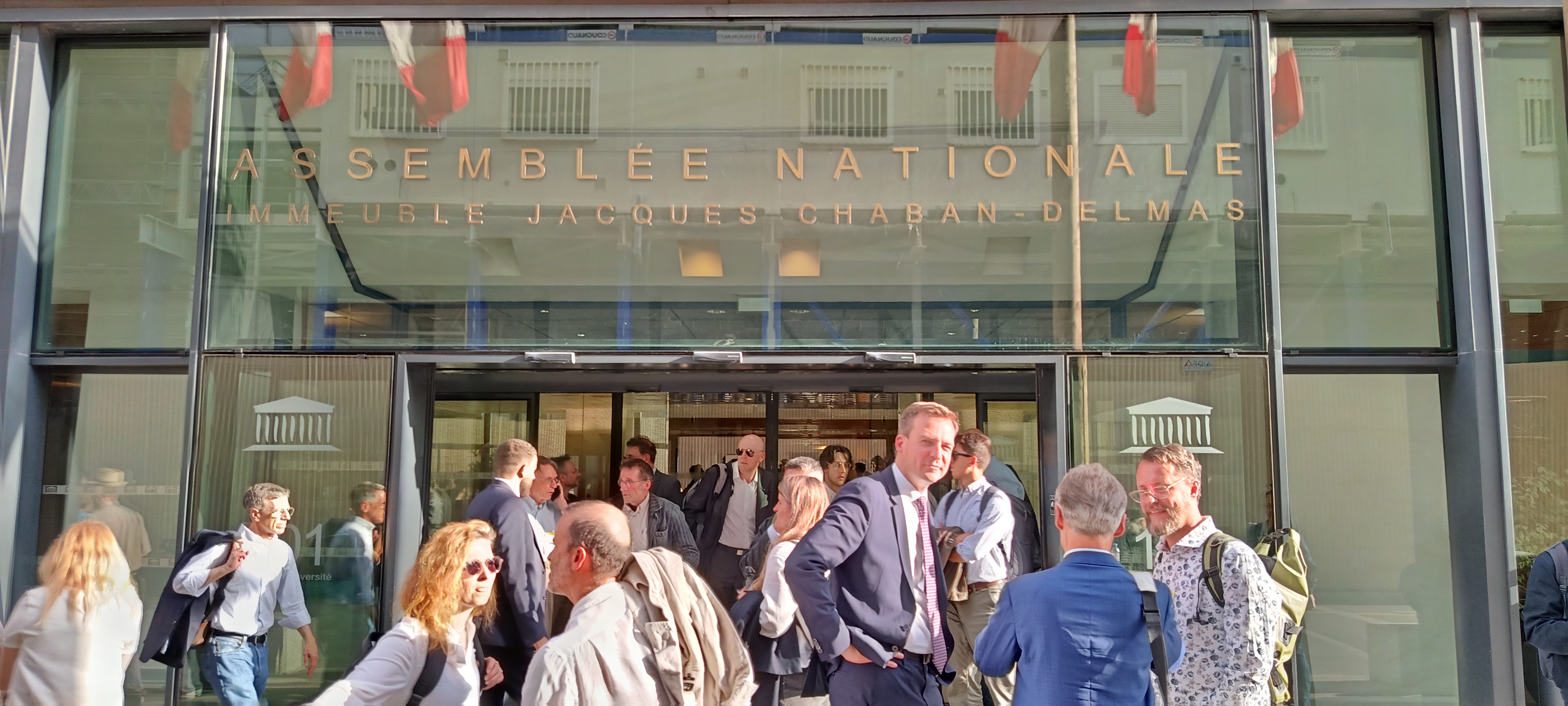
"The subject lends itself to smiles, and we know it," acknowledged MP Pierre Henriet (Horizons) in his opening remarks. "It carries that air of the unusual that makes for good headlines. Since the announcement of this symposium, we have observed the media coverage that naturally followed: the stereotypes, the little flying saucers used as illustrations, the knowing winks. We are not complaining about it—we smile along with you."
THE "UNTOUCHABLES" OF SCIENCE?
"This subject provokes contrasting and ambivalent reactions; people alternate between astonishment and snickering," continued MP Arnaud Saint-Martin (La France Insoumise) in his introductory remarks. A sociologist of science and CNRS Research Director (currently on leave during his parliamentary mandate), specializing in the economics of space and himself an amateur astronomer, he recalled: "'Do you actually believe in it?' people have asked me." "'Why hold such a symposium?'" "'What's the point?'". "We are haunted by the American approach: 89% of reports worldwide come from the United States, but things also happen in France," observed Arnaud Saint-Martin.
How does public authority organize the study of observations that remain unexplained to this day ?In order to bring this issue out of specialized forums and put an end to fantasies, the two MPs—both members of the French Parliamentary Office for Scientific and Technological Assessment (OPECST)—brought together researchers, engineers, military officers, public officials, and what they described as "serious" observers.
Among them were Luc Dini of the Sigma2 Commission. The Sigma2 Commission served as the UFO working group of A3F, the French Association of Aviation and Aerospace Professionals. The speakers also included data scientist and founder of the UAP Check network Michaël Vaillant, along with journalist and non-profit organisation Sentinel News founder Baptiste Friscourt, who is currently completing a Ph.D. at the University of Burgundy focusing on Unidentified Aerial Phenomena (UAP) ; academics such as the science sociologist Pierre Lagrange; Frédéric Courtade and Gilles Munsch from GEIPAN; and two spokespersons from the French Air and Space Force.
A CROSSROADS OF WORLDS
Journalists, representatives of associations, experts, and ordinary citizens concerned by the subject... nearly 250 of us were present in the auditorium, selected from the hundreds of registration requests submitted online.
Several attendees had traveled from Italy, Portugal, Switzerland, Germany, and Spain. Philippe Ailleris, one of the symposium's speakers, who has served as a project manager at the European Space Agency for the past thirty-five years, had come from the Netherlands.
The numerous cameras present—including those of Arte Germany, the parliamentary teams, and independent production crews such as Simon Méheust from the Et Pan! channel, Eva and Grégoire from The Paranormal Show, along with several specialized YouTube channels—gave the event in the Victor Hugo Hall the bustling atmosphere of a congressional hearing.
Among the audience, one could spot the French filmmaker Dominique Filhol, director of Valensole 1965, beneath his trademark cap; journalist Jean-Pierre Troadec, with his silver hair (author of the Que sais-je? volume Les OVNIs); the tall silhouette of Jacques Vallée; and the navy-striped tie of naval historian Alexandre Sheldon-Duplaix. EuroUFO, MUFON France, SCEAU, SUAPS, and the Repas Ufologiques network were also well represented, with participants arriving from Paris, Toulouse, Marseille, La Turballe, and other cities.
OPEN DISCUSSIONS
The round tables first sought to define the boundaries of the phenomenon, from the perspective of the social sciences to that of aeronautical engineering. The second focused on clarifying the missions and methods of GEIPAN, giving the floor to its director, Frédéric Courtade, and to one of its investigators, Gilles Munsch. The third and final session sought to take a broader view, encompassing politics and the international dimension.
Sociologist Pierre Lagrange—who has spent decades analyzing the mechanisms of what he calls the "Great Divide," separating "official" and "scholarly" sciences from the "untouchable," popular, and supposedly "irrational" sciences of ufology and parapsychology—recounted how accusations of conspiracy thinking have, over roughly the past twenty-five years, since the X-Files era, largely supplanted earlier accusations of irrationality.
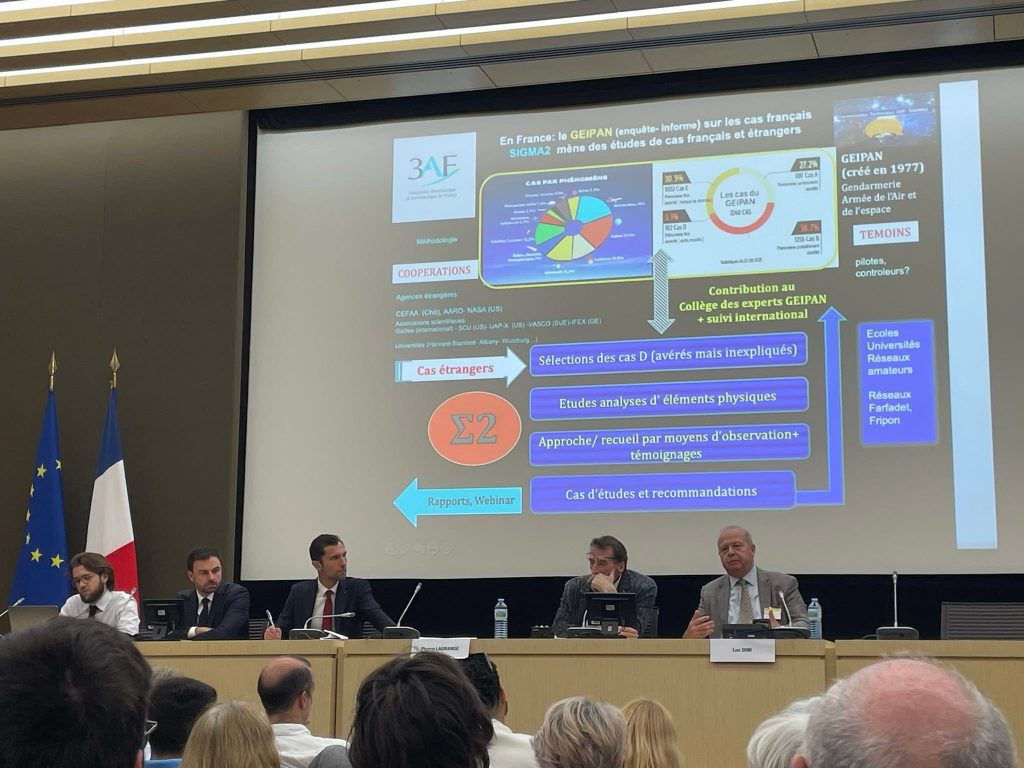
At the opposite end of the spectrum, the need for data was emphasized by the symposium's most scientifically oriented speakers. Philippe Ailleris, Project Manager at the European Space Agency (ESA), explained why the UFO issue remains a challenge in terms of observation, data production, and the management of uncertainty.
Luc Dini, Chairman of the Sigma2 Commission and also a senior executive at Thales, concluded his presentation by encouraging both civilian and military pilots to report their observations in order to improve research.
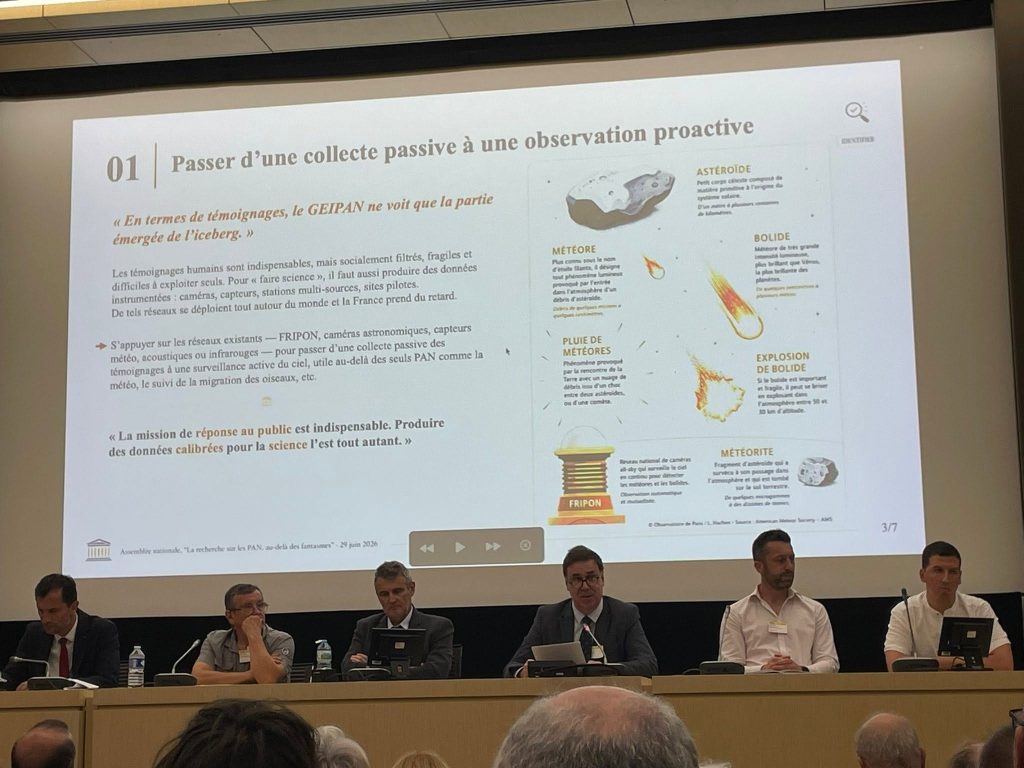
The same message was echoed by Michaël Vaillant, a data scientist based in Toulouse and a collaborator with GEIPAN for three decades. He shared his reflections on the value of a proactive, learning science—perhaps even a dual-use one—capable of simultaneously safeguarding national security interests and preserving the openness of academic research. He also emphasized the need for standards: a common framework capable of establishing "international standards related to the identification of phenomena and the way they are taken into account."
In other words, a lucid effort—and adequate resources—will be required if we are to reduce the realm of the unknown.
Each presentation lasted only fifteen to twenty minutes and was illustrated with five or six presentation slides. Every one of them was met with unanimous applause from the audience.
THE AMERICAN QUESTION
Each round table concluded with a Q&A session with the audience. Short questions — grossly 1 minutes—to keep the discussion moving. The moderators also ensured gender-balanced, which offered a tactical advantage to the women who raised their hands. I was unable to ask my own questions about NATO or the emerging global alliance of parliamentarians. I was probably too far from the front rows—and too male as well.
But among the very first to stand up was Jacques Vallée's neighbor. The man with the navy-striped tie: naval historian Alexandre Sheldon-Duplaix. He targets the big unspoken thing lurking in our minds. "One question for you, gentlemen parliamentarians. Why have you not mentioned your American colleagues who spoke this week and last week? The contrast is such that it deserves to be highlighted, with Florida Representative Luna asking the White House to protect whistleblowers who can lead anyone who wishes to the locations where recovered craft are held, along with the biological remains of non-human beings… These are the Luna’s Quotes."
A moment of hesitation spread across the speakers' platform. Silent glances were exchanged between the Members of Parliament and their assistants. The seconds ticked by, almost holding their breath. Part of the audience had straightened up in their seats, both curious and delighted by this sudden intrusion of UFO Realpolitik into the discussion.
Through his direct and unambiguous question, the historian had struck exactly where it mattered. He was precisely pointed out the elephant in the corridor—or rather, in this case, the Republican eagle. Alexandre Sheldon-Duplaix had brought up the subject that was not supposed to be mentioned, yet the one that everyone had in mind: the American-style disclosure.
It was the question.
The one on everyone's lips, and which had largely contributed to the political will of the two French MPs to take up the subject. But how could it be addressed? How could one avoid crossing that red line, which resembled a set of guardrails?
Behind the distance and restraint displayed by the parliamentarians lay a taboo that Sheldon-Duplaix had openly broken. That taboo encompassed the non-human biological samples mentioned under oath in 2023. It encompassed the reverse engineering of recovered "alien" craft dating back to 1947—or perhaps even earlier. That now of the existence of humanoid bipeds or ‘sentient’ (i.e., conscious) plasmoid entities, again reported by Grusch on June 9, 2026, on the steps of the United States Congress.
In short, how not to go too far and get lost the ever-expanding cascade of extraordinary revelations from across the Atlantic?
THE FRENCH STATE OF THE DEBATE
To cut short the growing sense of discomfort, it was first pointed out that this issue belonged precisely to the third and final round table—the one devoted to political discussion. "We don't have all the answers," added French Representative Saint-Martin. "The aim of this conference is to shift the focus toward France. It's the bet we've taken, which is arguably debatable. But we are initiating the debate."
The question therefore resurfaced once again at the very end of the symposium, still as politically incorrect as before. The French sense of reserve? The contrast with the revelations emerging from the U.S. Congress? Any Protection for UFO whistleblowers? Of course the Members of Parliament were in favor, Pierre Henriet explained, with some effort and many rhetorical precautions.
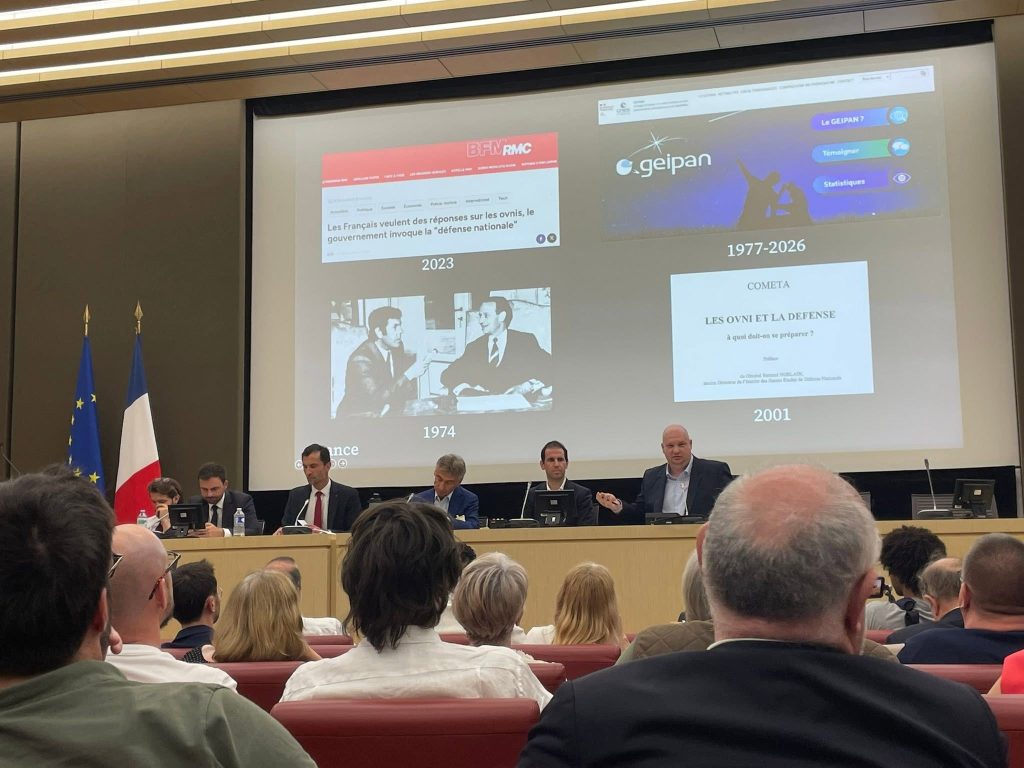
In the end, it was the former French government adviser Sylvain Maisonneuve who broke the ice with a convincing answer. "It is a question of maturity. The debate has not reached the same level of maturity in France as it has in the United States." Thus, there is no point,for now, in trying to address subjects that were too extraordinary or too divisive. Given the current French context and the present state of the national debate, doing so would be counterproductive.
The abscess had finally been lanced.
A FIRST STEP FOR MEMBERS OF PARLIAMENT,
A GIANT LEAP FOR THE INSTITUTION...
This never-seen French meeting marks a first step. It provides a clear framework to begin "politicizing" the UFO topic, which has fallen into parliamentary desuetude in France since November 2014, when the OPECST hearings and report on the overflight of French nuclear sites both stunned and alerted the authorities.
But in the Senate, in 2014, the word UFO was never uttered. One had to go back to November 1954, in the aftermath of the famous wave of sightings that had proliferated in the skies – and sometimes in the fields – of the French countryside under Pierre Mendès-France. It was then that the Prime Minister of the time decided to create SEMOC, the Service for the Study of Mysterious Celestial Objects. This office, within the Air Force, prefigured the GEPAN, which was ultimately established in 1977: nearly half a century ago.
"The subject is therefore already, whether we like it or not, an object of public policy," noted Pierre Henriet—the current Member of Parliament, former President of OPECST, mathematician and philosopher of science—in his opening address. The closing presentation by former ministerial adviser Sylvain Maisonneuve offered Members of Parliament several possible lines for future action.
Among them was the creation of a parliamentary "Mission Flash"—a short-term fact-finding mission—which, he suggested, "would be a good idea."
The Members of Parliament will now begin working on recommendations.
To add, undoubtedly, other initiatives to follow, suggested Pierre Henriet and Arnaud Saint-Martin. They also confirmed that the entire conference would be made available online in the coming days as a replay. "What happened here will be publicly available, in full transparency. That seems important to us," Arnaud Saint-Martin emphasized in his concluding remarks.
"What happened here today will be made publicly available, in complete transparency. We believe that is important," Arnaud Saint-Martin emphasized in his closing remarks before bringing to a close this unprecedented gathering, unlike any previously held under the French skies.
- - -
All pictures by Charles-Maxence Layet, but for the featured photo by Francisco Mourao Correa (SUAPS)