
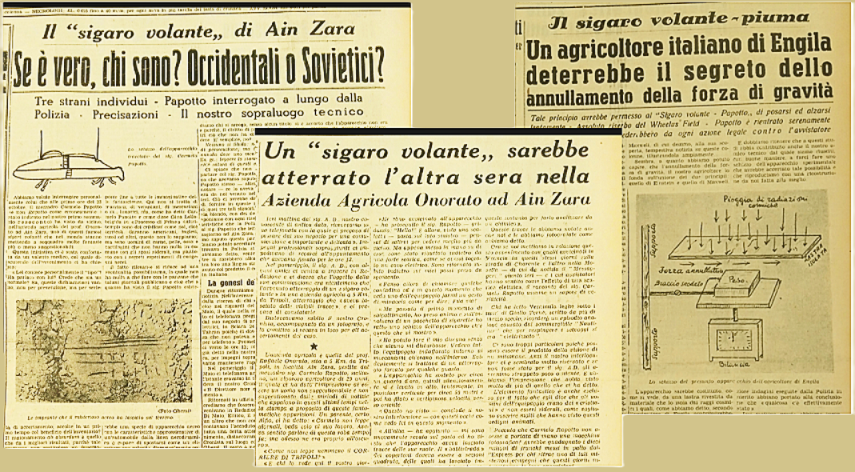
One of the consequences of Italy’s defeat in World War II was the loss of all its colonies. The Treaty of Paris of February 10, 1947, formalized our definitive renunciation of our holdings in Africa (Libya, Eritrea, Somalia) and in the eastern Mediterranean (the Aegean Islands).
Complex—and often tragic—events followed, which over the course of several decades saw the vast Italian communities in those territories decline and then nearly disappear. In the case of Libya, our compatriots—who were very numerous, partly due to the geographical proximity, and concentrated mainly in Tripolitania—still numbered 45,000 in 1945. This presence would come to an irrevocable end only in 1970, with the total expulsion of Italian nationals ordered by Colonel Gaddafi’s regime one year after he seized power in the coup that had overthrown the pro-Western monarchy of King Idris.
In Libya, Italian cultural institutions and economic activities were flourishing. Among other things—and this point is of particular interest to us—daily newspapers and periodicals in Italian were well established in that North African country, as well as in Eritrea and Somalia.
And it is precisely a significant example of the “importation” into that part of the world of the then-nascent phenomenon of flying saucers that this article will address.
UFOs and Colonial Culture
The spread of UFO-related narratives in the former Italian colonies during the 1950s and 1960s has been explored very little. We know a bit more about their presence in the French-ruled territories of North Africa, where it is plausible that, in addition to small waves of reported sightings, some nascent interest in the phenomenon had also taken root, only to dissipate with decolonization. As for Eritrea, Somalia, and Libya, however, our knowledge consists of only a few fragments, almost exclusively reflected in what was reported in the national press. A small wave, for example, occurred in Eritrea in the spring of 1950, coinciding with the first major phase of Italian interest in flying saucers. And there are some glimpses regarding that same territory and Somalia in connection with the massive wave of 1954, but overall, there is very little. Newspapers such as Il Quotidiano Eritreo and Corriere Eritreo likely served as vehicles for these reports, as well as Corriere della Somalia (we know a bit more about the latter than the others). The most interesting case, however, is undoubtedly the Libyan one.
In that country - we are now sure - Il Corriere di Tripoli played a decisive role; this newspaper was published from late 1911 until 1960, when it was shut down by the Tripolitanian authorities and replaced by another publication with a different title. It was in the pages of the Corriere di Tripoli that, under the pressure of the flying saucer craze that began in Italy in early September 1954, a series of events unfolded between October and November, culminating in the encounter between an Italian settler and a “flying cigar” that landed in front of him one night. This story has long been known in broad outline to Italian scholars, as it was mentioned from the very beginning in Italian daily and weekly newspapers. However, until not long ago, no one had been able to consult the primary sources of the story—a series of sensational articles published in the Corriere di Tripoli. Edoardo Russo remedied this gap in October 2023 by retrieving these sources from the Library of the Ministry of Foreign Affairs in Rome, where he consulted what is likely one of the very few surviving collections of the Tripoli daily.
The first thing that was thus clarified is that the Tripoli newspaper was very late (and rather restrained) in reporting on the “disc” craze that had already been sweeping Italy for several weeks due to the trend originating in France. It was likely forced to do so by the overwhelming force of the news, which the national community was undoubtedly discussing as well—especially since, of course, Italian newspapers were available at newsstands in Libya every day, and everyone listened to RAI radio news broadcasts.
The first signs that the craze was spreading to the inhabitants of Tripolitania date back to the edition of Wednesday, October 20, 1954. Two evenings earlier—according to a brief article in the Corriere—four people leaving a public establishment had seen “something resembling a large cigar” streaking across the sky over Tripoli. The next day, on the first major spread finally dedicated to what was happening in Italy and elsewhere, there was another mention of a “flying saucer” sighted in the sky over the Case Operaie neighborhood—likely, moreover, a reference to the episode already reported. On Friday the 22nd, another short article: a Libyan from Tripoli—not an Italian—had told the newspaper “with some modesty” that two evenings earlier, on the stretch between Zuara and Tripoli, he had seen “something strange, like an elongated spindle—that is, the classic shape of a flying cigar.”
Perhaps influenced by the uproar coming from Italy and France over sightings of what had been called “flying cigars” (a large balloon seen over Rome on September 17, the “super-bolide” of October 14), the newspaper’s editorial staff immediately opted without hesitation to describe local sightings rather than “discs.” This general trend—the spread of the craze to our former colonies—as already mentioned, also manifested itself in Somalia during those weeks, where a handful of sightings were reported, often by our compatriots, though they began later than the peak of the Italian craze and were, in any case, reported by the Corriere della Somalia in Mogadishu without particular emphasis.
Throughout all of this, however, nothing seemed to foreshadow what was about to happen.
An Insisting Visitor to the Newsroom
On Sunday, October 24, 1954 (it would seem the newspaper was published rather late that day), on the front page and prominently featured, readers of the Corriere di Tripoli found an article with a sensational headline: A “flying cigar” reportedly landed the previous evening on the Onorato farm in Ain Zara. The “things” everyone had been talking about so much had finally landed right in the heart of Libya’s Italian community.
The unsigned article was incredibly rich in detail. My opinion is that it was the work of the newspaper’s editor-in-chief, Marcello Moisé Ortona (1922–2002), who served as editor-in-chief of the Corriere from 1945 to 1957, during difficult times for him, for the Jewish community in Libya to which he belonged, and for the rest of the Italians living there.
A Mister A.D., clearly an Italian, had called the newsroom asking that someone come to his store for an “important and sensitive” matter. The editor had been unable to attend the meeting, initially scheduled for 1:00 p.m., and so, on the afternoon of the 23rd, A.D. showed up at the Corriere in Tripoli with some friends, claiming that a “flying cigar” had landed five kilometers from the Libyan capital and had left traces on the ground. Precisely to verify those traces, he requested that someone from the newspaper be sent to the site immediately. His request was granted: a reporter and a photographer set out right away.
Let’s keep one fundamental fact in mind right from the start: at that time, just a few kilometers east of Tripoli, there was one of the largest U.S. air bases in the world, Wheelus Air Force Base, from which there was extremely heavy traffic of all types of aircraft, including some of the most advanced of the time. With the end of Italian rule, Libya had become a crucial military hub for the United States and Great Britain, and Wheelus AFB was a key site in the confrontation with the Soviet bloc.
The presence of U.S. military personnel and the arrival of the world—and the imagery that accompanied it—had a powerful cultural impact on Libya: the future had literally arrived on its doorstep, with all its promises—and all its threats, given that strategic bombers also stopped there, destined, if necessary, to deliver nuclear warheads to the Soviet Union and its allies. And, to tell the truth, the story that the Corriere di Tripoli presented to its readers has a distinctly menacing quality to it, something that foreshadows war—and not interplanetary war.
The site of the alleged incident was the grounds of a farm in the town of Ain Zara, a town five kilometers south of Tripoli, now part of the greater Tripoli metropolitan area.
That farm, owned by Professor Raffaele Onorato, was managed by a tenant farmer born in a small village in the province of Catania, a twenty-nine-year-old man whose name was given as Carmelo Rapotto (we’ll see later that there was an error in his last name). According to the reporter, “Rapotto” struck everyone as a solid, down-to-earth man, with little interest in the subject of flying saucers and devoted to his work.
A Warplane and Its Many Devices
According to the reporter, the man had recounted that at 3 a.m. on Saturday, October 23, after making his rounds to check on the guards at the Onorato property, he had gone to an area that had been plowed earlier that day with the intention of sowing grass, when at a certain point he saw “something shining in the sky,” but he hadn’t paid it much attention, partly because at that very moment he heard the roar of engines—and it certainly wouldn’t have been the first time, even at that hour of the night, that he’d seen planes and helicopters flying over the sky on the farm.
But this time, according to the report in the Corriere di Tripoli, “the luminous apparition” had descended to the ground a few dozen meters from the man, settling “silently on the ground like a blanket of snow”—a poetic image for a genuine explosive device such as the one about to be described.
The reporter explained that he had personally conducted an investigation (the details of which were not specified, but one can assume that measurements were taken on site) together with A. D., the man who had first reported the story to the newsroom. It could be inferred that the alleged aircraft would have been rather small: “a chassis about 2.50 meters wide and 3 meters long,” from which the journalist deduced a fuselage 5–6 meters long and three meters wide—an impression shared not only by him but also by the witness.
But what matters most is that the appearance of the aircraft (the entire account has the tone of a revelation of an aeronautical secret, and the term “aircraft” appears throughout) had been reconstructed by the farmer in a rudimentary sketch that would be published in the Tuesday, the 26th, edition of the Corriere.
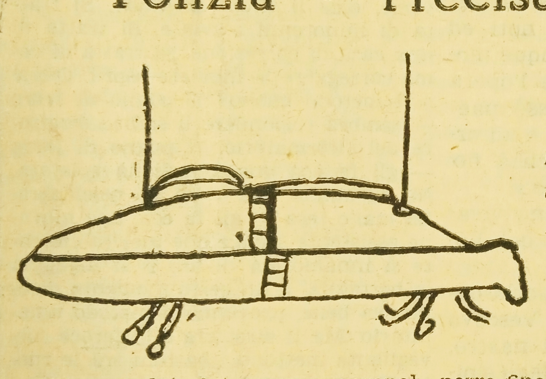
Even more surprising, however, was what was said about the overall appearance of the aircraft:
It has the shape of an aerodynamic car with a tail, which evidently serves as a rudder.
It’s as if you were reading a description of Nuvolari’s cars – a steel monster that, rather than darting through the sky as one would logically expect from a flying cigar, can glide along the ground. After all, just a few kilometers from the meeting site, in addition to Wheelus Air Base—home to the new aerial monsters of the atomic age—there were still the tracks of the Mellaha racetrack, one of the legendary sites in the Italian collective imagination during the Fascist era. From 1933, when it was inaugurated by the colony’s governor, Italo Balbo, until Italy’s entry into the war in 1940, the racetrack hosted the Tripoli Grand Prix, which had previously been held in the city and on which another forbidden dream of Italians—who were happy with everything Fascism gave them—depended: winning the Tripoli Lottery, tied to the standings of that car race.
Returning to the description of the aircraft: the underside of the plane was white, and according to the witness, it was made of aluminum—another myth of the aeronautical technologies of the heroic age of flight and also of UFO lore ever since the colossal wave of airships that had invaded American skies in 1896–97—and above it was a transparent material divided into sections. On the nose, to the right and left, were two holes, and, at the center of the forward fuselage, a convenient external ladder. The aircraft rested on six wheels: four in front, arranged in pairs 1.85 m apart, and two in the rear, 50 cm apart. A monster, yes, but rather compact—in short, similar to, but smaller than, a fighter jet from the first half of the 1950s.
There were also some slightly more exotic features: beneath the fuselage (the witness had walked around the aircraft without any hurry) were two “horn-shaped” tubes. At the nose and tail, there were standard radio antennas, with the former even connected to a transceiver. And it certainly appeared to be a warplane: from the rear “protruded two machine-gun barrels with perforated sleeves,” exactly as was the case with many machine guns of the time—for example, the American Browning M2s that everyone had seen in previous years as squad weapons, or mounted on the turrets of tanks and other armored vehicles, primarily the Allied ones that entered Tripoli in January 1943, and more recently, in newsreels documenting the Korean War.
“One from the North”
Now, the witness could clearly see what was inside the plane, since it was illuminated by “a very bright white light provided by eight quadrangular lamps.” They cast beautiful beams of light two to four meters around, perfectly suited to serve as theatrical spotlights for the climax of the show: inside the plane, they illuminated “six men clad in yellowish suits with their faces covered.” No visible facial features, then? No possible identification suggested? Who were those six men?
Don’t worry: at one point, one of the six “had to uncover his face and blow into a tube.” The reader was meant to know whose it was—the flying cigar. So here is the reporter’s question to the witness:
What did this guy look like to you? What kind of face did he have? A Martian?
No, the point of the story wasn’t that he was a “Martian.”
A Martian? I don’t know what race he was! He looked to me like someone from the North. I don’t know—an American, an Englishman, a Russian! I couldn’t say, because I didn’t ask for his ID card.
Not at all frightened, the witness had approached, shouting a plausible “Hello!” and had seen the access to the deepest secrets: a ladder on the left side of the aircraft. He had tried to climb it to get a closer look, but as in other UFO accounts from those years, he was prevented from reaching the climax of the experience. When he placed his hand on the ladder, he was “thrown back by a strong jolt, as if I’d touched an electrical cable.” Dismayed, he backed away, stunned by that energy-based anti-intruder system.
After this first frustrated attempt—the one that would have allowed him to see the innermost recesses of the craft—the account moved on to its second part with yet another denial: the failure of the attempt to extend the experience from the individual to others, as is, after all, the norm in this kind of story.
The encounter with the “secret” had to remain private, individual—because it was too precious. The witness had thought of calling over a few farmers, but he’d seen one of the crew members make a threatening gesture toward him, as if to say, “Get lost.” He’d therefore given up, though not without trying to sketch the plane’s appearance on the wrapper of a pack of cigarettes, drawing it while it was still on the ground. He continued, however, to observe from a greater distance what he had been prevented from seeing more clearly by the “discharge” resembling that of “an electric cable”: the crew working “around some mechanisms” inside the aircraft. “Evidently, it was a forced landing due to some kind of malfunction” —here we see another recurring motif from early accounts of encounters with flying-saucer pilots: the fortuitous circumstance arising from a temporary malfunction of the aircraft or the witness’s discovery of the crew’s exploration of the area, disrupted by the witness’s arrival on the scene and, as a rule, interrupted by his agitation.
The farmer, however, despite what he has witnessed, remains there, quite at ease. There is nothing rushed about this story. Everything unfolds very slowly, in a leisurely, time-stretched manner.
The craft hovered for about a quarter of an hour, then silently rose upward, slowly, in a vertical position for about 50 meters, and then sped off at breakneck speed toward the east.
A few hours later, the witness confirmed the persistence of the event’s evidence. Upon returning to the scene, he had in fact seen that the treads of the cigar-shaped craft’s tires had left square-shaped tracks, covered by a greenish film. There was only one such track, he was keen to point out: if it had dragged along for a long time, a much longer stretch would have been visible. Instead, he insisted, that was precisely the proof that the aircraft had landed perpendicularly and then taken off again in the same manner. A. D., the man who had been the first to report to the Corriere di Tripoli—and whom the witness described as “a friend of mine”—had even collected a sample of soil impregnated with that substance (the “greenish film”) to have it examined by a chemist. Just as in other similar incidents, an associate of the witness now intended to have more than just his friend’s word: there were concrete signs, examinable in a laboratory, to support the oral account.
The writer for the Corriere di Tripoli seemed impressed by certain details: the “electric discharge” described by the witness—wasn’t it perhaps the same one mentioned in an article in Rome’s Il Messaggero, which had arrived in Tripoli on the 23rd, by French witnesses from the Charente and Moselle regions? Moreover, the witness made no mention whatsoever of “extraterrestrial beings”: his were “Christians,” men like us—and thus, for the newspaper, it could be ruled out that “the fantastical element” was at the heart of that story. And then another account had also come to light: a trucking company owner, Mr. Fichera, and his driver had also seen, a few evenings earlier, one of the flying cigars.
Photos, suspicions, and some controversy
In reality, the tumultuous story of the “flying cigar” of Tripoli was just beginning. In the days following the first article—and again through the Corriere—an incredible controversy erupted, consisting of trivialities, disagreements that were more or less resolved within a few hours, and sharp clarifications that received disproportionate coverage in the newspaper for several days—even more coverage than the “cigar” itself, which was attributed to some unidentified power.
After the break on Monday, October 25 (as was customary at the time, newspapers were not published on the first day of the week), the Tuesday, October 26 edition once again devoted half of the front page and part of the third page to our incident. The newspaper’s stance was now clear: it had either been an aircraft from a Western country, a Soviet aircraft, or one from a country allied with the Soviets. In the first case, there would have been little to object to, but in the second, there would have been trouble.
But, aside from that, the tone of the story was taking on the feel of a spy thriller fueled by fantasies about Cold War superweapons. The witness’s brother (by the way: his name was Papotto, not “Rapotto,” as mistakenly written in the first article) had recounted that on the morning of Sunday the 24th, Carmelo had received a visit at the Onorato farm from three men who had aggressively demanded that he hand over the sketch of the mysterious aircraft he had drawn while the “thing” was still in front of him. Papotto had reacted angrily, saying he would give it only to the authorities (to be honest, the first thing one notices in the Corriere article is that the drawing was prominently displayed, and thus it was already clear to anyone going to the newsstand what it was: perhaps the decision to publish it was made only after the witness’s heated exchange with the small group?). The three, however,
left after addressing the witness in Italian, but they were chatting among themselves in an unspecified foreign language. Papotto later added further details in person while speaking with journalists. One of the three had dark hair—he must have been a Tripolitan—while the other two were blond. They had introduced themselves to his uncle, Angelo Georlandino, and the witness had then joined them: they were in a station wagon-style Vanguard—a typical American car of the era, manufactured by Standard. Papotto had gotten into the car, and at that point they had asked him for the sketch. He had replied that he had given it to the Corriere di Tripoli, which was “a government publication”—therefore, the sketch would be published through that channel, the “official” one. They had whispered among themselves, perhaps in French, insisting on having the sketch. Intimidated by their attitude and taking advantage of a slowdown in the car’s speed, he had gotten out, and they had almost apologized for the request, claiming they wanted the sketch only “to see what it looked like.”
In short, an encounter with a trio of secret agents who were somewhat clumsy and uncertain, with the witness coming across as almost reckless in comparison to the “three individuals.”
For his part, the Corriere editor didn’t hesitate to stir things up further—it was clear that the newspaper was now at the center of the controversy. Why hadn’t Papotto, who had gone to the newsroom on the morning of Monday the 25th, mentioned that visit to the newspaper’s editors even then? Why had they had to learn about it from his brother? Furthermore, around midday on the 25th, Papotto had been questioned by the police—and we know nothing about the possible outcome of that.
The Corriere di Tripoli reporter was also keen to clarify “the origins of the story”: the first to report on the incident had been the shopkeeper Antonio Di Maio (the man who had previously been identified only as A.D.). On the afternoon of Saturday, October 23, since they had been unable to visit him, the journalists had been visited by Di Maio’s son, a man named Alfio Racito, and another man, and it was they who had told the story for the first time. Only after that interview did the reporters go to the scene of the incident, accompanied by a photographer. On the morning of Monday, October 25, after speaking with Papotto, the Corriere reporter became convinced that the story was neither a fabrication nor the result of the witness’s eccentricities—all the more so (an interesting detail) because Papotto had explained that, for personal reasons, he would have had no intention of making the story public if it had been up to him. However, it so happened that he had asked Alfio Racito to take some photos of the company; when Racito asked him why he was making that request, he was eventually let in on the nighttime adventure that Papotto claimed to have experienced. Other details of the story also emerged—details that were even more… detailed. At first, Papotto had thought he was looking at an American helicopter; the gesture made by one of the crew members toward him was not a threat, but an order to stay still; he had seen one of the six wheels beneath the aircraft being removed and reattached, which then retracted into a compartment after the crew member pressed a button—all without paying much attention to the witness’s presence…
Rather than an encounter with a flying saucer, it felt more like a visit to an improvised aircraft maintenance center, with the secret aircraft clearly visible to a farmer who happened to be passing by.
Were there any seats on board? Of course there were: one was at the front, in front of what Papotto thought was a radio—after all, sitting there was an operator, wearing headphones and connected by wires—and then two other crew members, who were standing in front of instrument panels (to the witness, that was the cockpit). Two more seats were further back, and a sixth was near the wheel that had been removed and reinstalled. Six seats and six crew members, then, were the ones he had seen, one by one. He had also pieced together the time the incident began more accurately: 3:25 a.m., lasting a total of a quarter of an hour. He was angry with the editor-in-chief of the Corriere, Marcello Ortona: he claimed he’d already had too much trouble over that matter because of the newspaper, adding that if he ever saw another strange plane in the future, he would be careful not to report it “even if it were loaded with sterling pounds.”
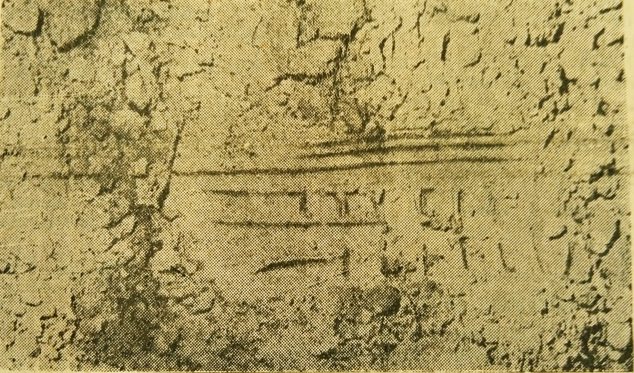
The Corriere had the tracks (above: the photo published in that article) examined by an automotive technician, Emanuele Japichino, who described them in detail in a statement reproduced by the newspaper. They were tire tracks, likely from solid tires, with tread patterns indicating they were from a “common commercial type.” Overall, the front tire tracks appeared paired “like common truck tires.” Details followed regarding the dimensions of the tracks, which were consistent with those of truck tires. As for the bluish tracks (and not green, as initially reported), they corresponded to sections of the tread, which had a quadrangular shape. According to the expert report, they could have been caused by “a protective substance that is normally applied around tires in storage to protect them.” However, the technician was awaiting the previously announced chemical analysis—the one mentioned in the first Corriere article—to determine their precise composition
Japichino was keen to point out, however, that he felt he could rule out “artificial compression” of the tires, for various reasons. From the photos taken (though Japichino had not personally inspected the ground, which had by then been trampled by onlookers), there was nothing else around the tire tracks; moreover, they appeared to him to have been left with extreme precision, showing what looked like a longitudinal movement—perhaps caused by something during landing or takeoff. One could argue that the traces of a possible manipulator might have been deliberately erased, but he could not find a valid reason “why one would resort to this ploy.”
In short: wheels that looked perfectly normal, but—based on the photos Japichino had seen—had arrived in that field in an unusual way—that is, from above.
Plot twist: the three mysterious men show up!
One might think that, as the hours and days passed, the commotion surrounding the story would die down, but that was not the case at all. And so, on Wednesday, October 27, another full page of more or less idle musings appeared in the newspaper, featuring exchanges between the various protagonists, minor controversies, and heated little twists.
Meanwhile, on the morning of Tuesday, October 26, as the Libyan police continued their investigation, the Corriere reported that “British and American experts” had also arrived on the scene. When questioned, Professor Paolo Onorato, the owner of the company where Papotto worked, spoke very highly of him, even though he knew Papotto’s brother better than he did: he did not believe it was possible that Papotto had made up such a story, because he was a simple man, dedicated to his work, and beyond reproach. One reader, for his part, wondered whether the radars at Wheelus Air Base had detected anything, and Editor Ortona replied that, although he knew the commander personally, even if something had been detected, they certainly would not have gone to tell him about it. Ortona, the editor of the Corriere di Tripoli, had, however, contacted an Italian official at BOAC—the leading British airline of the time—and through him had learned that the civil air traffic control tower in Tripoli had not detected anything out of the ordinary during the time period Papotto had indicated for his encounter. Of course, the witness and others who had been at the scene said they had suffered from headaches—perhaps due to exposure to toxic substances left behind by the “flying cigar”—but, at least on this point, the newspaper played down the story and did not go so far as to link it to the account of the mysterious aircraft. None of the journalists—Editor Ortona and the photographer, who had also been at the scene for quite some time—had experienced even the slightest symptom: for the Corriere di Tripoli, these were vague cases of illness, linked to the incident solely through autosuggestion.
In any case, there were still column after column of text, written in a bombastic and verbose style, essentially adding little or nothing. To tell the truth, there was something new, and it had to do with the small circle of people that had formed around the flying cigar over the past few days. The three mysterious individuals who had wanted the drawing from Papotto had revealed themselves. They were neither Martians nor secret agents, police officers, or journalists, but three citizens who, out of curiosity, wanted to learn more from the witness. And it was at this point that the story of the flying cigar, for a moment, risked leading to a complaint. The article recounting this incident is a mile long: I’ll try to summarize it, because otherwise you wouldn’t make it through alive.
First, however, another significant disappointment, found in the same article: the failure to analyze the traces of the “landing gear”—an analysis that had recently been promised. Di Maio, the first to tell the story to the Corriere di Tripoli, had agreed with an expert, a certain Dr. Niccoli, to analyze the “bluish substance” collected from the traces. But then, nothing came of it. Di Maio merely added that he agreed with the assessments of the expert Japichino: it must have been a protective substance for tires. So there was no point in conducting the analyses and spending a lot of money on something like that! In short, whatever it was, the idea came to a standstill there.
As for the small group of three, they consisted of a lawyer, a dental technician, and a company executive. The lawyer had asked Papotto and the journalists to come to his office so he could explain what had really happened; then, the three of them, growing impatient, had gone in person to Ain Zara and asked for the witness. The witness, calm and smiling, had recounted the story to them as well, and in fact, had taken them to see the traces, which he had covered with a sheet of metal. They had taken photos together. He had also shared other details: the men on board the aircraft were wearing “trunk-shaped” masks. He had been able to see their facial features because at one point one of them had lifted his mask to blow “into a turbine”—not “into a tube,” then, but into an engine like the ones we earthlings use in airplanes. The lower part of the aircraft was said to be made of something resembling glass, while the upper part was white metal, perhaps aluminum. It also emitted a noise “similar to that of a trolleybus compressor”—which suggests the man was referring to a propulsion system comparable to that of an electric vehicle.
They had asked him to show them the sketch he’d made in person, but he refused. “But how?” they retorted. “His drawing was about to be published in the Corriere di Tripoli—everyone would see it!” And here came yet another twist: the drawing that was about to be published had been made after his encounter with the mysterious aircraft. And what did he intend to do with the “real” one?
Well, he wanted to go to Rome, at his own expense, and hand it over personally to the Italian government. Sensational developments seemed to be on the horizon: the “real” drawing of the mysterious plane was to go to the authorities in our country!
It was at this point that the misunderstanding arose. Papotto, in a statement of his own that was also published, essentially explained that he had become frightened after getting into the car with the three men, not knowing who they were. When he refused to show the sketch—which he intended to reveal only “to the competent authorities”—he reportedly added that he “didn’t expect anything” in terms of profit, and that it was “just a whim of his.” At the insistence of the man sitting next to him in the back seat—who was concerned about the direction the situation was taking—he suddenly got out of the car, while the others were almost apologizing for what had happened. A trivial episode, one might say, were it not for the fact that the three, feeling outraged by the way the interview had been reported in the 26th’s edition of the Corriere, threatened to file a complaint through their lawyer!
Ladies and gentlemen, here come more players on the scene!
By now, it seemed as though almost everything that could happen in this world had already happened. After four days of intense media attention focused on the story, and in the absence of further developments, the life cycle of this story seemed destined to enter its final phase—but that was not the case.
In its Thursday, October 28, edition, the Corriere di Tripoli wanted to treat its readers to one last thrill. The cast of characters in this saga was destined to expand even further, until the lineup of characters in this crowded drama was complete.
While the editorial staff tried to calm the three individuals offended by Papotto’s statements and the story was being vehemently debated throughout the city, the newspaper attempted to defend the witness from another perspective as well. It seemed that the lawyer, given the tracks, was skeptical about the reality of the incident: they seemed “shallow” to him, for a vehicle that had fallen from the sky and was presumably quite heavy. For this reason, he had consulted Japichino again, the automotive technician who had already offered his opinion. He assumed that the craft was “an airship” and that, therefore, it had landed gently, without the force of free fall. The type of terrain, moreover, was very compact. It’s not entirely clear why, but he believed it was possible that the aircraft weighed “a metric ton.” How he had arrived at those calculations remained unknown. On the other hand, the editorial staff argued once more, it was either an enemy aircraft or one from a friendly nation. In either case, why had there been no activity from the American base, located just a few kilometers away?
And besides, wasn’t there some corroborating testimony to support the story? As always in the history of ufology, all you have to do is ask aloud, and other people’s accounts start coming in. In our case, in the Saturday, October 30, edition of the Corriere di Tripoli, the witness was a well-known farmer in Tripoli—also an Italian—Commendatore Giacomo Grandi. At 10:00 p.m. on Friday, October 22, while riding his bicycle on the railroad bridge in the Case Operaie neighborhood, he had seen, for about twenty seconds, a glowing mass of greenish light, spinning and moving very quickly toward the west. According to him, it wasn’t far away: 600 or 700 meters. A trivial sighting, whatever it may have been (perhaps, incidentally, the same one we mentioned at the beginning, just on a different date?), but what matters is that the Corriere di Tripoli was now giving it disproportionate significance, linking it without a doubt to the story of the landing which, after all, “had taken place just five hours earlier”—a timeframe that, evidently, was considered irrelevant. Aside from the ongoing minor controversy over the threat of a lawsuit—the lawyer was still keen to point out that he and his two friends had been entirely cordial during the meeting on the morning of the 25th—it was reported that the police had conducted a series of interviews: they had questioned Di Maio and the three members of the group of onlookers, but it seems that nothing substantially new had emerged from the matter.
However, at the end, there was one interesting detail, likely added by the newspaper just before going to press. According to the Corriere di Tripoli, the police—after thoroughly questioning Papotto and conducting several on-site inspections—had become convinced that the aircraft was certainly not “a Martian spaceship,” but rather “an aircraft of Nordic origin, both in terms of design and construction.” What such a statement meant is by no means clear. It could be said that, in its first article, the newspaper used the term “Nordic” to refer to the United States, Great Britain, or Russia. In short, assuming this corresponded to reality, it would seem that the Libyan police believed the man had mistaken some aircraft—perhaps stationed at Wheelus Air Base—for something mysterious. In any case, the newspaper also reported that none of the other many residents of Ain Zara had seen anything unusual, although it attributed this to the fact that, for years, people in the area had been accustomed to the heavy traffic from the U.S. base.
“Flying cigars”? They were invented right here
No way: the Corriere di Tripoli was insatiable. Perhaps the creator of the flying cigars like the one described by Papotto wasn’t a Northerner—he was an Italian, and he lived in Tripolitania! Don’t you believe it?
A reporter for the newspaper had gathered information from an unnamed technical official, according to whom, in the town of Engila—about twenty kilometers from Tripoli—a farmer had been conducting experiments for years “in a special well” aimed at overcoming gravity. The story, which appeared in a follow-up article on Friday, October 29, offered an explanation for our episode that was improbable to say the least but consistent with the entire narrative cycle we’re exploring. The device devised by the Italian farmer was coated with a material that “insulated it from cosmic rays.” Between the plate and the weight of the aircraft, a force was produced that generated “an absolute vacuum, like Torricelli’s,” and so on, rambling on about things that made no sense.
There was also a crude little sketch (reproduced below) that was supposed to illustrate how the flying super-machine, conceived by the farmer with a passion for physics, worked.
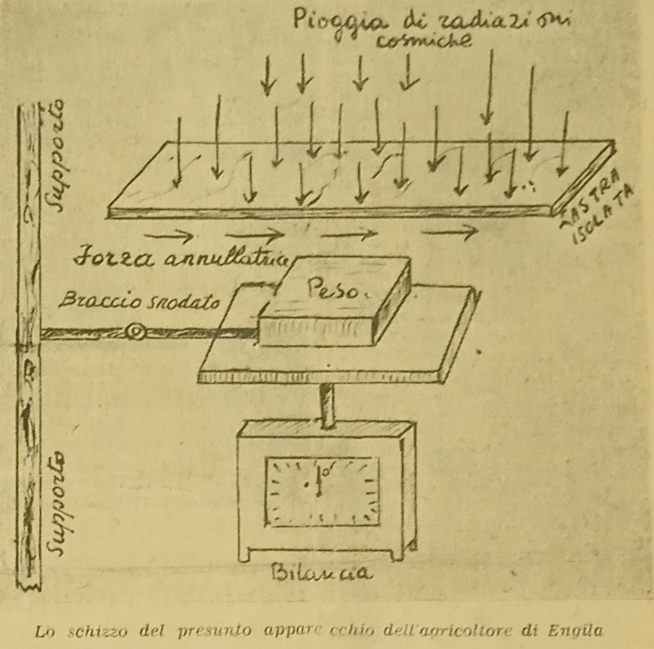
Perhaps it was precisely because it operated on those principles that “Papotto’s mysterious aircraft” had descended and ascended “like a feather or a flake of snow,” in perfect silence. A somewhat Italian aircraft, then, capable of defying gravity, and conceived near the witness’s home.
This interpretation, as outlined in the Corriere di Tripoli, is also the framework I will suggest for this long series of newspaper articles: a brief cycle that arises, develops, and fades entirely within the framework of the idea of an advanced vehicle belonging to a foreign power—one of those that, with their futuristic technology, dominated the world in the mid-twentieth century and did as they pleased—but perhaps with a touch of Italian genius at its core.
Meanwhile, the minor storm surrounding the threatened lawsuit seemed to be subsiding. According to the newspaper—whose editor was gloating over rising sales thanks to the “flying cigar” story—the lawyer and his friends had likely decided to hold off on taking legal action. There was, however, at least one more sobering detail. A reporter from the newspaper had been sent to Wheelus Air Base to ask if they had any comment on the incident. He was received by a captain and by Mr. Dibb—apparently a civilian clerk—who stated they knew nothing about that.
As the month drew to a close and after a week of intense coverage, the incredible flood of words produced by the Corriere di Tripoli finally began to subside. There were other sightings and some signs of the stir the story had caused in Tripolitania, but little else.
On October 30, thanks to the Caffè Garibaldi in Tripoli, we learned that a few nights earlier, the Martians (there they were, finally, the Martians—at least in the publicity) had landed at night on the café’s terrace to enjoy the specialties of the renowned establishment; On the 31st, the news was that the previous evening, at sunset, another mysterious flying object (that’s exactly how it was described) had been spotted in the sky by a group of people gathered at the War Memorial in Tripoli: it shone with a silvery light and had passed in front of the Sun; yet another mysterious flying object, this time dark blue, had appeared again in Tripoli on the evening of Saturday the 6th (Corriere di Tripoli, November 9). Then, after sixteen days, the frenzy came to an end.
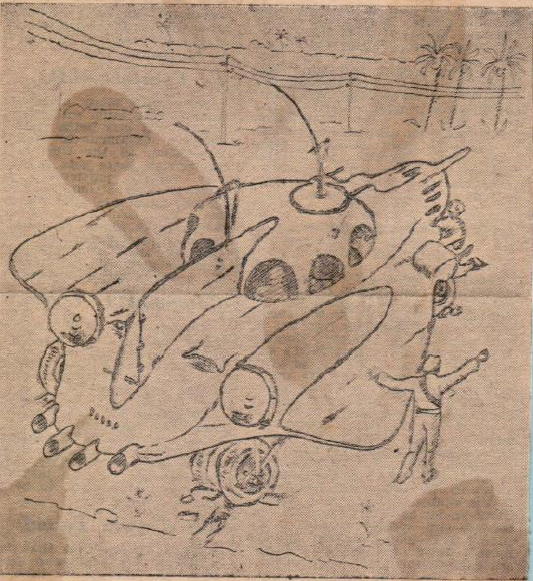
In the meantime, however, there had been another small surprise. A Tripoli weekly—this time an English-language newspaper serving the British and U.S. military forces (https:// libyanheritagehouse.org/wheelus-a-microcosm-of-american-life/wheelus-newspapers)— the Sunday Ghibli, had summarized—in a slightly ironic tone—on October 31 the enormous coverage the Tripoli Courier had given to the story, but added three interesting details. The Ghibli had spoken with officials at Wheelus Air Base who, after stating that no aircraft at their disposal was capable of performing such maneuvers, expressed interest in learning more; apparently, residents of the Ain Zara area—where the incident took place—had pointed out that there were numerous power lines running overhead, making it highly unlikely that an aircraft could have landed there; therefore—according to this cautious assessment—it could not have been a helicopter, nor a helicopter that had lifted a truck with a winch…
The icing on the cake: a magnificent artist’s impression of the mysterious object, rich in detail and truly much more like a supercar than an aircraft of the future.
Resonance in Italy and Later Fame Among Ufologists
The “Papotto case,” as it has long been called by ufologists, had been known for a very long time to Italian enthusiasts of the subject, albeit in a far more limited form than that found in the primary sources—namely, the lengthy articles in the Corriere di Tripoli recovered by Edoardo Russo in 2023.
The story received widespread coverage in Italy because, occurring almost at the height of the massive UFO wave that swept our country in the fall of 1954, it prompted the Tripoli office of the ANSA news agency to devote time and staff to the story. The result was a lengthy dispatch dated “Tripoli, October 29,” which was picked up the following day—often on the front page—by a very large number of newspapers across the peninsula; among other things, it placed the episode on the wrong date—namely, 48 hours earlier than the date indicated from the outset by the Corriere di Tripoli. From ANSA, the story made its way into newspapers around the world.
The text contained some significant details: the aircraft was like “an aerodynamic car”, it had descended in complete silence, and the face Papotto had seen was that of a “normal man.” After he had been “thrown backward” by the electric shock, one of the crew members had signaled to the man to stay still. As for the landing site, the ANSA correspondent had examined the ground and had also seen the tracks “of rubber-coated wheels.”
The width of the tires appears to be about 10 cm, with a tread pattern consisting of quadrangular sections. Each parallelogram in the tread pattern is said to have a side length of about three centimeters. The tracks suggest four wheels—presumably the front ones—arranged in pairs as on a tractor-trailer (with an axial distance of 1.85 meters between the two pairs and a distance of about 10 cm between each pair), as well as two presumed rear wheels with an axial distance of 50 cm. Compared to the front wheels, these two wheels appear to be arranged at an angle. Meanwhile, they appear to be centered relative to the front axle. The distance between the two axles is 3.30 meters.
In all other respects, the account was entirely similar to the details reported by the Corriere di Tripoli
As far as we know—likely also because the incident occurred abroad—no Italian ufologist ever managed to contact Papotto or the other key figures in our story. Based on the ANSA dispatch, in issue no. 32 (January 1971) of the Turin magazine Clypeus, the ufologist and esotericist Solas Boncompagni (1922-2017) finally brought it to the attention of Italian enthusiasts. The account was faithful to the ANSA text, but what was original—and heavily adapted to the classic ufological imagination—was the accompanying drawing, the work of the remarkable illustrator Marco Rostagno (1935–2004).
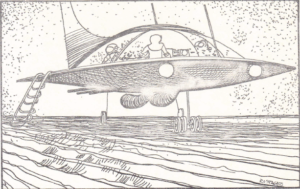
It thus became what it had not been in the original account: a veritable flying saucer.
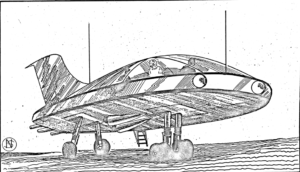
The following year, in issue no. 10 (January 1972) of the Florentine monthly Il Giornale dei Misteri, following in the footsteps of his close friend Boncompagni, it was the turn of journalist and parapsychologist Sergio Conti: once again, the usual ANSA dispatch, but also in this case—by now no longer a surprise—another visual reinterpretation of the aircraft, this time by one of the magazine’s longtime illustrators, Silvio Neri, whose initials “SN” appear in the image, which now bears a strong 1970s aesthetic.
In reality, on the international stage, the episode had already gained a certain fame for some time, because in 1969, based on unclear sources cited in the footnote as “personal information,” the French-born American ufologist Jacques Vallée had included the story in the famous catalog of alleged UFO landings, an appendix to his third book, Passport to Magonia. Some details mentioned by Vallée differed from what the primary sources indicated (the aircraft’s egg-shaped form, the sound of a compressor produced as it descended—whereas, according to the Corriere di Tripoli, it was extremely quiet—and a few other points). Vallée vaguely alluded to the fact that “reliable investigations” had been conducted. Nineteen years later, in 1988, curiously, in another of his books, Dimensions, he added some details (for example, the fact that the tracks had been photographed), though once again, unfortunately, without specifying his sources; but, in essence, until the recovery of the lengthy articles from the Libyan daily, nothing else had been possible to add to the more or less slapdash accounts of the episode that had been put forward over time.
Martians, Americans, or something else? A Cultural-Historical Assessment
In all likelihood, we will never know if—or what—happened on the outskirts of Tripoli, Libya, on that now-distant night. Virtually all of the information on this story is due to the work of the editors of the Corriere di Tripoli, who, naturally, produced what they deemed appropriate: a series of sprawling articles intended to keep readers’ attention for as long as possible. The only sources we have, therefore, belong to the genre of journalistic reporting. Moreover, they are the product of a small linguistic and cultural community that had entered the final phase of its history. They reflect the dynamics, controversies, petty squabbles, and debates of a specific and relatively small context, which, in some ways, resemble those of the Sicilian province described by Vitaliano Brancati during precisely those same years.
It is in such an environment that the editors of the Corriere di Tripoli interpret everything that, without a doubt, the eyewitness to the landing of the foreign “flying cigar” found himself having to explain at great length, after one of his friends—the ones to whom he had recounted his nocturnal adventure—had rushed, perhaps rashly, to the newspaper’s editorial office.
For a week, in a heated collective debate filled with explanations, drawings, controversies, attempts to produce evidence, minor twists, and, above all, a succession of interpreters, all of them together contributed to the symphony that the Corriere di Tripoli, with unquestionable narrative skill, was able to construct and present to the readers of that time and to us who are rediscovering it today. We must take care to respect the score of that symphony of voices, for it is that—and nothing else—that comes before our eyes as historians today.
What the Corriere di Tripoli has passed down to us—albeit with Papotto as the lead voice, the one standing foremost on the proscenium—is a chorus, and also a debate that never strays beyond the bounds of decorum. There will be no lawsuit, and no one will suffer any harm, because of the secret of the flying cigar—American, British, or Russian?—spotted for a long time that night near Tripoli while its crew was repairing it.
For the rest, as a historian of ufology, my assessment is that the narrative structure of the story makes it resemble what I call the “terrestrial phase” of the history of Italian encounters in the early years of ufology with the crews of the “discs.” It was also a brief phase: it arose and faded between the summer and fall of 1952, even though there were subsequent offshoots.
Four famous episodes exemplify this “terrestrial phase,” all of which appeared in the media within a little less than four months—that is, between late August and mid-November of the year in question. It should be noted that these are the accounts through which, in Italy, chance direct encounters between witnesses and the crews of the “discs” first appeared—because as early as the second half of the nineteenth century, systematic contacts with inhabitants of other worlds had existed in our country, but they were linked to spiritualist, occult, and theosophical circles of various kinds (a distant example: Lincos; Stilo, 2026), and took place through methods suited to those cultural contexts (mediums, automatic writing, magical practices, “magnetization,” and so on).
The four incidents to which I refer are the one in Abbiate Guazzone, made public in late August 1952 (Stilo, 2000, pp. 186–99); the one in Lucca, publicized in late September (Stilo, 2002, pp. 289–298), the one at the Scerscen Glacier (made public in late October, ibid., pp. 308–332—a well-known photographic hoax, though it did suggest the possibility that the beings might be “Martians”), and the one at Castelfranco Emilia (in mid-November, ibid., pp. 340–350).
What are their defining characteristics? First, two of them (Facchini, Rossi) attest to the introduction into ufology of the myth of the “death ray,” the electricity-based superweapon that had first been discussed in the early 1870s and had reached the peak of its popularity between the two world wars—an idea that, in the Tripoli incident, is represented by the detail of the “electric shock” that prevents the settler from boarding the aircraft. In the Ferrari case, it is the “sound of electric motors” described by the witness that indicates the persistence of the myth of electricity as the fundamental source of energy that powers or defends flying machines—in the Papotto case, the aircraft is perfectly silent and, perhaps, operates thanks to antigravity technology developed by an Italian in Libya. In the Facchini case, however, the witness narrowly escapes when he is shot at with a “cursed beam of light.” The myth of the “death ray” is more significant for ufology than historiography has recognized. As far as I can tell, the initial role in linking the mystery of flying saucers, their terrestrial origin, and electricity—both as a weapon and as a propulsion system—involved, prior to the emergence of the cases from the summer and fall of 1952, the presence of two “triggers”: the first, and most important, was the release in Italian theaters in March of the first true and seminal UFO-themed film in history, The Day the Earth Stood Still, in which the decisive factor in convincing earthlings of the aliens’ power is, precisely, the use of the “death ray”—in the version that has been absolutely central to that myth since immediately after World War I—to disable every type of engine and electrical power generation system. The second element, which between the spring and fall of 1952 spawned a very long series of stories, predominantly of German or French origin, was the development of a series of versions of the myth of flying saucers invented by the Nazis (Verga, 2023), in which the Reich’s secret weapons fall into Soviet hands, and the Soviets are now testing them across half the world, giving rise to waves of flying saucer sightings. Along these lines, in mid-July 1952, shortly before the brief series of Italian cases involving encounters with flying saucer pilots began, the Italian press widely publicized the story recently recounted by a refugee from Soviet-controlled East Germany, Oskar Linke, who claimed to have seen, a few months before fleeing the East, a flying saucer and its Soviet crew land in a clearing: a story that the German and European press interpreted entirely within the framework just outlined—that of “flying saucers” as a Nazi invention that had fallen into Russian hands—and whose description was reproduced two months later quite faithfully in the account of the Lucca case (Stilo, 2002, pp. 296–7). Subsequently, in early August 1952—a couple of weeks before the Abbiate Guazzone case kicked off the series of Italian cases—our newspapers carried a story that had been entirely fabricated two months earlier in Germany, claiming that another Soviet flying saucer of Nazi origin had crashed on the Svalbard Islands in the Arctic and had been recovered by the Norwegian military: the system that powered it caused electromagnetic interference with the aircraft that had discovered it. The pilots of these discs, like those in the Papotto case, wore suits and oxygen masks (Papotto, at least in his interview with ANSA, spoke of a helmet with a proboscis, just like in the Abbiate Guazzone story) or similar gear, another clear indicator of the “aeronautical” context in which these stories are set—crews of super-modern, stratospheric aircraft; Even more significant is the theme of ongoing breakdowns, repairs, or maintenance—in the Papotto case, represented by a problem with one of the six wheels of the takeoff and landing gear, which, along with the reason for surveying the area, serves in this type of story as the immediate cause of the witness’s discovery of the aircraft, as the witness observes it for a long time, sometimes partially hidden, sometimes in plain sight, under the watchful eyes of the technicians working on their aircraft. In the Facchini case, the technicians leave the leftover pieces from the welding on the ground; in the Rossi case, however, they need water from the Serchio River, over whose bed the flying saucer descended to refuel. The military and “political” nature of the story of the ultra-modern aircraft is confirmed by the continuing atmosphere of mystery after the craft disappeared; in the Lucca case, the witness risks being tricked by a strange man who offers him a drugged cigarette; police and military personnel interview witnesses, concerned about reconnaissance flights by potential enemies, or about the possibility that, unwittingly, the witnesses are revealing technological secrets that must be kept under wraps. The aircraft often feature a steampunk aesthetic; they are cumbersome, lacking anything “superior” or celestial, devoid of elegance in their baroque details, their knickknacks, spikes, antennas, protrusions, propellers, pipes, machine guns, bulbous Plexiglas domes, treaded wheels, turbines, oversized goggles, and proboscis-like breathing tubes… They cannot come from space: they come from workshops; they reek of oil and kerosene, perhaps of electricity; sometimes they dirty and pollute. They are ours; they are a product of our worst history—that of wars—not of the sky and its inhabitants.
As far as one can responsibly infer from the words left to us by the editors of the Corriere di Tripoli, Carmelo Papotto seems to be the last witness—or rather, the embodiment of a group of witnesses—to the Italian encounters with the pilots of the “flying saucers” that began in 1952. The new series, destined for far greater glory, the saga of Martians and extraterrestrials—later transformed into “aliens”—was just beginning as, toward the end of October 1954, the story of the Sicilian settler was being told. That new series would possess infinitely greater narrative and myth-generating power than the other, to the point of becoming, in the 21st century, a cultural theme of significance for all of humanity.
In this context, the ramshackle yet enduring charm of the flying cigar that landed at Ain Zara lies in its being, completely and without remorse, out of touch.
- - -
References
Lincos, Sofia; Stilo, Giuseppe (2026), “Vincenzo Orsini: A General and the Inhabitants of the Other Planets in the Solar System,” Query Online, CICAP, February 11, available here: https://tinyurl.com/w94t4a7c (https://tinyurl.com/w94t4a7c)
Stilo, Giuseppe (2000), Scrutate i cieli!, UPIAR, Turin
Stilo, Giuseppe (2002), Ultimatum alla Terra, UPIAR, Turin
Verga, Maurizio (2023), Flying Saucers from Naziland. The Real Story of the Nazi UFOs – Volume I, independently published
- - -
This article was first published in Italian on CISU website - Copyright and courtesy of the Italian Center for UFO Studies - Thanks to Stavros Hatzopoulos and Jeff Knox for reviewing the automatic translation
