
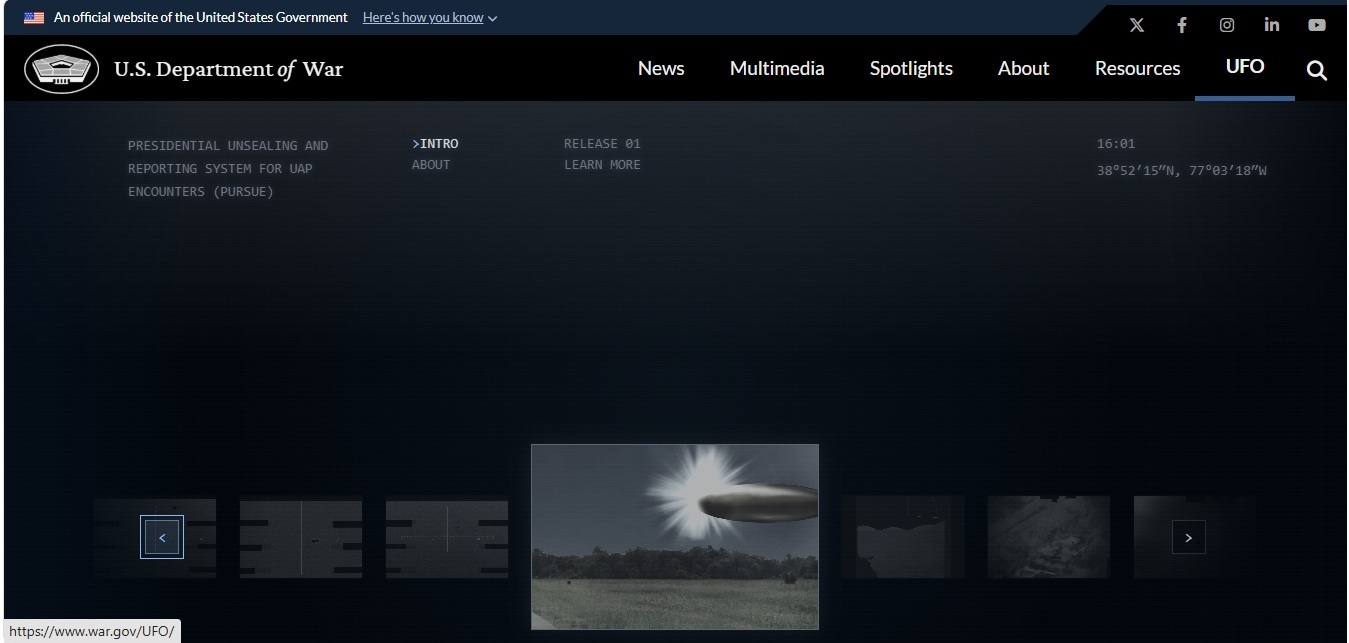
These are documents (sometimes extensive, sometimes extremely brief) accompanied by a short descriptive summary and, in many but not all cases, an indication of the location and date to which the event refers. The documents come not so much from the armed forces as from various agencies or offices of the government: the State Department, the War Department, the FBI, and NASA.
According to the information on the introductory page, the Pentagon is overseeing a broad program (named PURSUE: Presidential Unsealing and Reporting System for UAP Encounters) for the retrieval, examination, identification, declassification, and publication of unidentified UAP reports or historical documentation held by various branches of the federal government, with the clarification that “unresolved” cases refer to those for which the government has been unable to determine the nature of the observed phenomena (“for a variety of reasons, including a lack of sufficient data”). This is described as an unprecedented effort, involving dozens of agencies and the review of millions of documents spanning many decades; therefore, this is only an initial partial release, which will continue in the future.
The actual release, which had been announced a few times, has elicited varied reactions, aside from the predictable and widespread media coverage. In particular, advocates of “disclosure” (often understood as “revelation” rather than “declassification”) have been divided between those expressing enthusiasm for this “paradigm shift” and those who already suspect it is merely a smokescreen, limited to non-compromising documentation.
In reality, this is not exactly a “first”: as early as sixty years ago, the U.S. military initiated a process aimed at ridding itself of the UFO issue in the public eye: first by commissioning a three-year scientific study from a university, then by closing the office that (within Air Force intelligence) had been collecting and analyzing UFO sightings since 1947, and finally by publicly releasing its entire archive (hundreds of thousands of pages relating to over 12,000 cases) to the National Archives.
Not that the U.S. military had stopped dealing with reports, however: at the very least, those involving military personnel or equipment obviously continued to be collected and analyzed as part of the Department of Defense’s institutional duties. And for over fifty years, civilian researchers have sought out and often obtained the release of documents related to these activities, based on the Freedom of Information Act.
In December 2017, however, a turning point occurred: following a sensational investigative article published in the New York Times, a “snowball effect” ensued that brought the topic of UFOs (renamed UAPs) back into the spotlight of the mass media, the public, political debate, and even a certain degree of academic interest, as we have reported on numerous occasions in recent years. As early as 2020, political pressure led the U.S. Department of Defense to reopen an office tasked, among other things, with centralizing and analyzing reports from government employees, as well as locating documentation scattered across various government agencies: what is now called AARO (All-domain Anomaly Resolution Office), which is not, however, being replaced by the new initiative, so much so that the webpage itself references and links to the AARO site.
Civilian scholars have only just begun examining the newly released material, as well as what will follow.
It is worth noting that, unlike everything officially published in recent years—which seemed to avoid the old term “unidentified flying objects” in favor of the more neutral “unidentified aerial phenomena (and later, anomalous phenomena)”—this new webpage revives and uses the historic acronym UFO.