
One gets the feeling these states have had it: Enough is enough. Although the 2017 publication by the New York Times of the 2004 Nimitz incident and the existence of the Advanced Aerospace Threat Identification Program marked a turning point for the UFO subject, it wasn’t a right-angle turn, and subsequent predictions of significant UFO disclosure have to date been more illusory than actual. Meanwhile, UFO sightings continue unabated. While President Trump has said he “will be directing the Secretary of War” and additional government agencies to “begin the process of identifying and releasing” UAP files, none have yet been disgorged. Thus, we have the unique situation of three states taking steps on their own to acquire answers as to what, exactly, is flying about in their skies.
New Jersey Assembly Bill 5712
This bill, which became law on 12 January 2026, contains several provisions: an air traffic controller loan redemption program, another program to provide aviation grants to certain public educational institutions to support training in unmanned aircraft systems, establish aviation degrees in air traffic control and administration, and—most importantly from a UFO standpoint—to “support the establishment of a Center for the Study of Unidentified Aerial Phenomena.” This center will be administered by a yet-to-be-chosen “public institution of higher education” that applies to participate in this program and has the “capacity” to do so. A total of $2.5 million will be allocated annually for all recipients. The bill includes no specifics as to the structure, timing of reports, or other operational details of the UAP study center.
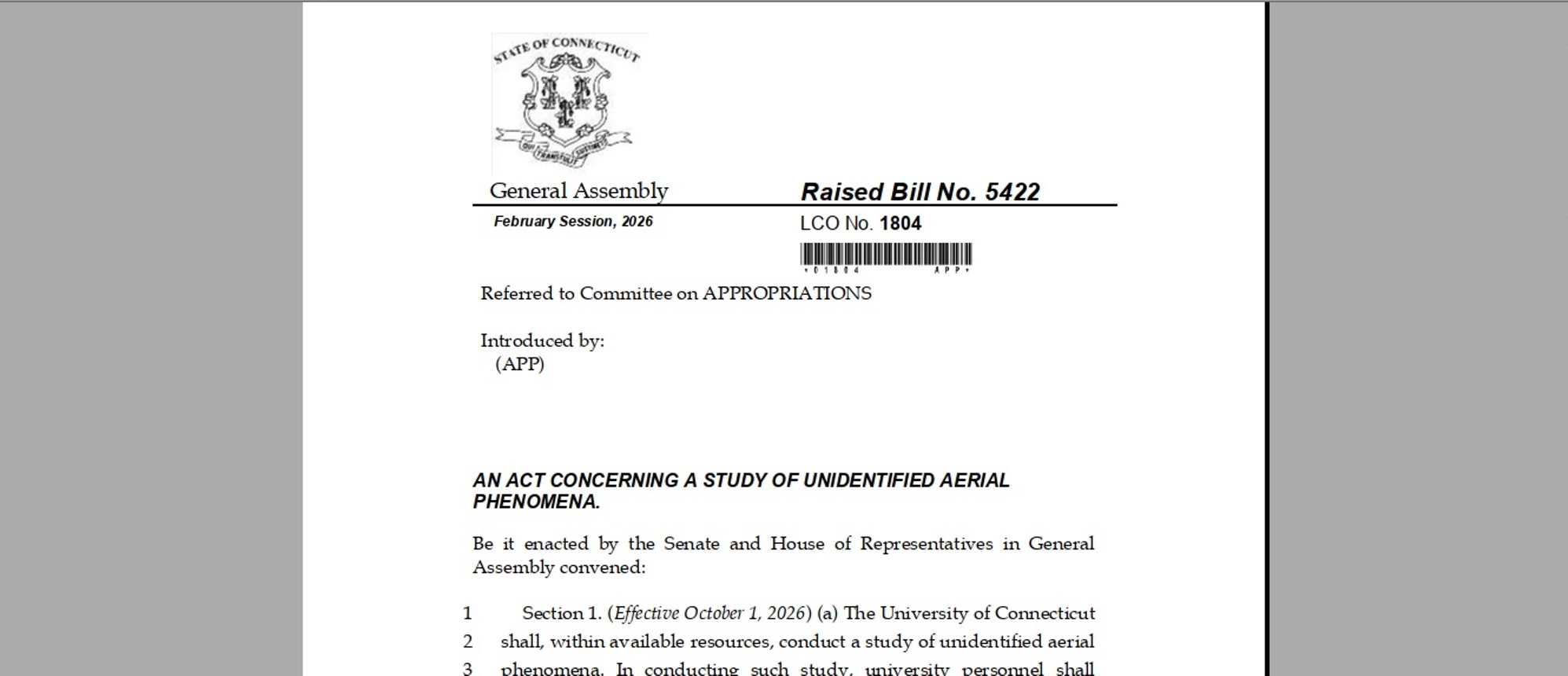
Connecticut Raised Bill No. 5422
The Connecticut bill is entitled “An Act Concerning a Study of Unidentified Aerial Phenomena” and is still pending, unlike the New Jersey bill. Its statement of purpose is simply “to require a study of unidentified aerial phenomena.” Unlike the New Jersey law, this bill stipulates the University of Connecticut will be the entity conducting the study, assisted by several state agencies as needed, including the Office of Military Affairs, and, amazingly, “the director of the Connecticut chapter of the national nonprofit organization dedicated to the investigation of UFO sightings, abductions, and other unexplained phenomena, as deemed necessary to obtain information.” Could that be MUFON? The MUFON Connecticut State Director was asked for this article if the statement refers to MUFON and him, and he replied he is unsure as to which nonprofit it is. However, he noted, he did voice his support to the bill’s sponsor. If the bill is passed without further amendment, the results of the UConn study must be reported “to the standing committees of the General Assembly” by 1 July 2027.
Vermont Bill H.654
In contradistinction to the bills of New Jersey and Connecticut, the pending Vermont legislation “proposes to create [a] Vermont Airspace Safety and Unidentified Phenomena Task Force to evaluate reports of unidentified anomalous phenomena, assess airspace and public safety risk, coordinate with academic institutions and federal agencies, and develop recommendations to improve reporting, response, and analysis.” Actually, almost nothing more need be said here. This is the job the federal government should have been engaged in publicly and continuously since 1947. Now Vermont has seized the UFO bull by the horns.
In addition to reviewing and analyzing UAP reports, the task force will share information and data with federal, academic, and private sector partners, assess any UFO risks to aviation and public safety, provide an annual report no later than December 15 to the governor and various state house and senate committees, “maintain a public web page,” and have at least one annual meeting to present its findings and “collect input.” The bill notes a confidential reporting system for UFO sightings “may be developed.”
The task force will be composed of 10 members, including one member from the state house of representatives, one from the state senate, an “academic expert in aerospace or atmospheric science,” and a person with expertise in radar or sensor systems. Worth noting is that the task force includes no expert—of which there are plenty—in ufology. However, the Scientific Coalition for UAP Studies (SCU) will provide technical assistance, being earmarked as “the principal scientific analyst for data and evidence related to unidentified anomalous phenomena.” So, in this respect at least, the task force members will interact with individuals who are knowledgeable about the complicated field of ufology.
We do a lot of hoping in the UFO field, and the above opportunities are more reason for hope that at least some answers to this complicated mystery might be shaken loose and, perhaps, produce a snowball effect, wherein the accumulated knowledge grows larger and larger as it rolls down its metaphorical hill.
This article was originally published in The MUFON Journal No. 696, April 2026
(c) Mutual UFO Network & Rob Swiatek