

Fourty years of activity by the Centro Italiano Studi Ufologici (CISU) mean four decades of work, initiatives, growth, and important achievements. As one of the founding members, I would like to take this opportunity to provide some historical overview of what we planned to do at the beginning and a balance of what we have managed to do since then.
Our mission was and is clearly stated in our Bylaws.
First and foremost, to investigate UFO reports. It may seem trivial, but even today, not all those who calls themselves “ufologists” have the collection and analysis of sightings as their primary objective. Having the investigation of cases as our primary focus means approaching the phenomenon with the attitude of a researcher, not a believer: we do not know what UFOs are, so we investigate to understand.
The second point was equally clear and is – even today – somewhat ‘revolutionary’, in that it involves promoting the scientific study of the UFO phenomenon, thus looking explicitly and consciously to science and not to those beliefs (lacking in evidence) which, today more than ever, poison the subject of ufology.
Our third goal is to promote the circulation of information on the phenomenon and its study, because research cannot be done without sharing data with those who can study it.
In the same vein, another of our objectives is to coordinate national activities of data collection and study, because an association must be able to connect and enhance everyone's contributions in order to achieve the best results.
Finally, we have set ourselves the task of collecting and preserving documentation on the subject of ufology in Italy, so as not to repeat the mistakes of those who came before us but were unable to build and maintain an adequate ufology archive.
40 YEARS OF WORK AND RESULTS
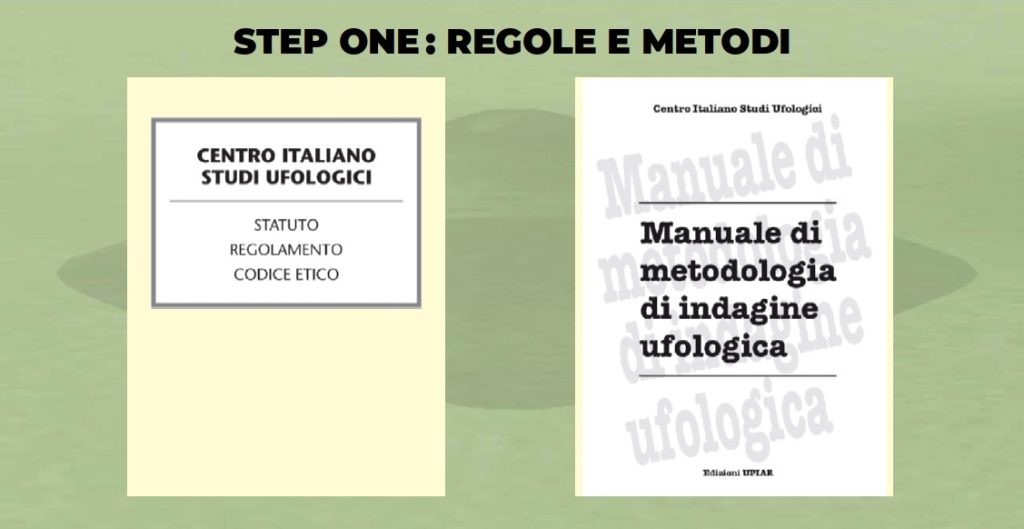
The first step in putting these social goals into practice was to equip ourselves with some precise methodological references. First, we expanded and updated the UFO Field Investigation Methodology Manual, which must be followed during UFO investigation work. Secondly, following the example of other foreign associations, we adopted a Code of ethics that clearly defines the limits and cares by our members towards other researchers, the public, and above all, witnesses, who must always be adequately respected and protected.
Starting from these premises, we have come a long way since 1985 and we are proud, and above all satisfied, to have succeeded in achieving many of the goals we set ourselves at the time, when we were in our early twenties.
FIRST TARGET: CASE STUDIES
Our first and most important objective has always been and continues to be UFO report studies, which means, first and foremost, investigations, which we have carried out for all the most important sightings collected over the years, creating not just investigation reports, but sometimes thick dossiers representing the highest possible level of knowledge of individual case histories.
Talking about case studies also means talking about collecting and cataloguing cases and creating archives. In order to best implement these activities, we have chosen and pursued two parallel directions of development.
First of all, we have continued the initiatives of local cataloguing of reports through the Regional Catalog Project, which over the years has seen various CISU members take on not only the work of collecting sighting reports within each one’s territory, but also the creation of regional archives and the compilation of regional catalogs summarizing what has happened in each Italian region. The coordinators of such regional and provincial catalogs, who have succeeded one another over time, have also followed and studied the cases in their area and have often produced monographic publications that are the result of a never-ending task because it continues on a daily basis.
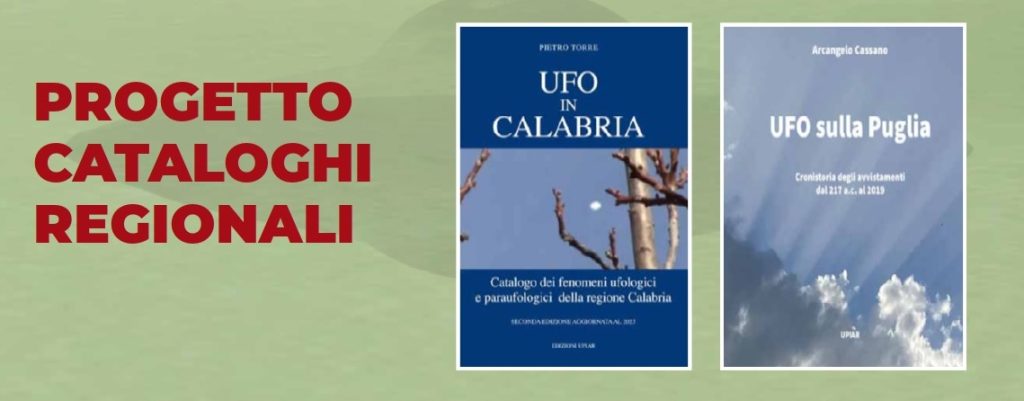
The last two examples published are UFO in Calabria by Pietro Torre and UFO sulla Puglia by Lello Cassano, two substantial books, rich in information that tell the entire ufological history of the regions concerned.
The regional catalogs have then been merged into a national catalog, which was recently made available online to the public. It now contains 43,000 Italian UFO reports: a wealth of information unmatched in quantity and quality, which represents an indispensable basis for any reasoning on the phenomenon, for any analysis that you may wish to make.
The second section of case studies consists of quite a few thematic projects, which collect and analyze UFO reports not on a local basis but by specific types or characteristics. We therefore have projects concerning sightings by pilots, PreUfoCat on unusual aerial phenomena in the centuries prior to 1900, ‘Progetto Italia 3’ on close encounters of the third kind in Italy, the catalog of cases with physical effects on the environment or on the witness, etc.
The “Operation Origins” project, dedicated to the early years from 1946 to 1954, deserves special mention, as it has generated an entire series of six books (one for each of those great waves of sightings: 1946, 1947, 1950, 1952, and two volumes for 1954).
In all such projects, there is a curator, an archive, and above all, the collaboration of the entire association to collect and convey all available relevant information.
THE ROLE OF THE HEADQUARTERS
Alongside the collection and study of UFO sighting reports, the other major pillar of CISU's activities is the archiving of all documentation or information of potential interest to research.
An important part of the archiving work is managed at the central archive in Torino. What was once a small office rented in 1979 has since 2002 become a large 187-square-meter headquarters, in a basement entirely occupied by the archive of the Italian Center for UFO Studies. To date, it is the only physical headquarters of a national ufology association in our country.
Thanks to the availability of this important space (the result of the financial commitment of some members), continuous work has been developed during weekly meetings dedicated mainly to work on the archive but also to updates and in-depth discussions, as well as visits by Italian and foreign researchers, for a total of well over 2,000 meetings.
During these years of incessant activity, the archive has grown to such an impressive size that it is now the second largest in Europe (behind only that of the AFU in Sweden, whose sole purpose is to collect and preserve archives from all over the world) and one of the five largest in the world.
The numbers speak for themselves:
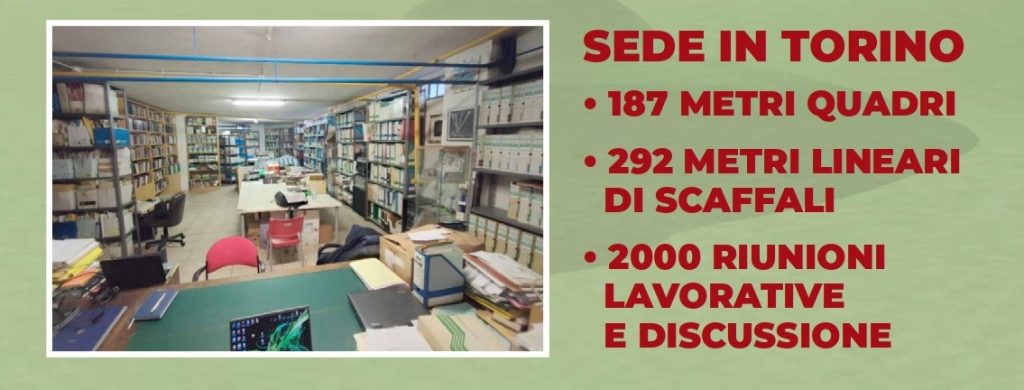
- the shelves total 292 linear meters.
- the Italian Case Archive collects all available documentation on 43,000 sightings.
- the Press Archive consists of 98,000 clippings and extracts from newspapers and magazines.
- the Book Library houses 670 Italian books and 1,715 foreign volumes.
- the Periodical Library consists of 272 collections of Italian specialized periodicals and 749 foreign ufology magazine collections.
- the Topic Archives are comprising all sources on specific topics often used for studies, including those by external researchers or for university dissertations, and consist of 144 dossiers totaling 15,000 pages.
For years, work has been underway to digitize the archives, which, although very time-consuming, is beginning to bear fruit. To date, 710,000 files have been archived and made available to our members, for a total of 5 terabytes on a NAS (Network Access Server), and CISU website contains 4,685 pages and files.
OUTWARD LOOKING
This enormous mass of information is not simply a collection of paperwork, of sources for its own sake. It is a real archive and, as such, a living, dynamic entity that is constantly changing and remains open to new entries and outcomes.
Beyond its collection activities, the archive is open and available not only to our members but also to all researchers. Beside cooperations within ufology, CISU has often provided information and documentation to users outside our field.
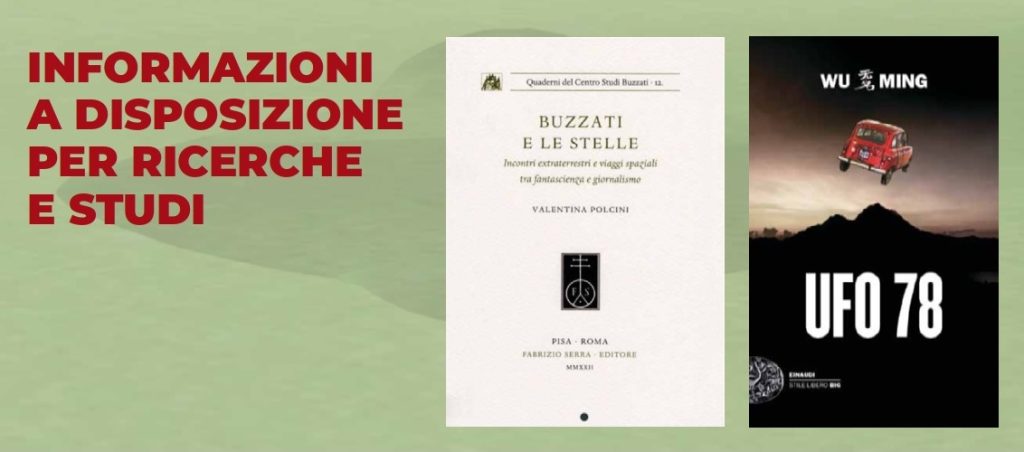
Last two examples: Valentina Polcini's academic work on “Buzzati and the Stars”, for which she got original sources from our archives about unpublished interactions between the famous writer and reporter Dino Buzzati and ufology; even more unusual is the novel “UFO 78” by the Wu Ming collective, which even drew inspiration from us young ufologists’ adventures to portray some characters and events in that book.
PUBLICATIONS
CISU has always produced information, both internally and externally.
In the years before the Internet, several internal circulars were produced for information or discussion, now largely replaced by real-time telematic tools.
The focus of our publications has always been “UFO - Rivista di informazione ufologica” (UFO Information Magazine), an aperiodical publication that tries to go beyond immediate news and current events, aiming instead for in-depth, comprehensive, and structured information, distinguishing which topics are worthy of attention and of real interest.
Then there are the books and monographs published by our own specialized publishing house (UPIAR Publications), which allows us to give space to technical works, research, and catalogs: almost 100 in total.
PUBLIC EDUCATION
It is almost impossible to offer a detailed account of the public education activities carried out over forty years, through conferences, newspaper interviews, and participation in radio and TV programs.
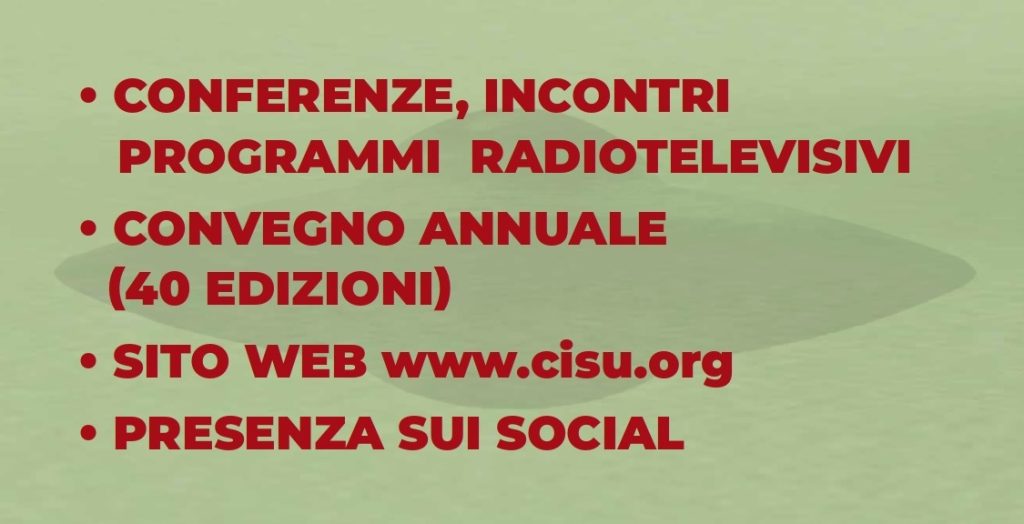
Then there is our annual conference, now in its fortieth edition, sometimes open to the public and sometimes managed as a closed-shop discussion meeting among ourselves.
Our web presence obviously plays a central role, as we were pioneers in Italy in this field since 1995, and more recently we have been active on various social media (currently Bluesky, Facebook, Instagram, LinkedIn, Telegram, Threads, TikTok, Twitter/X, and YouTube).
CISU INTERNATIONAL
CISU's presence and role on the international stage has also grown over the years, placing us at the center of many initiatives underway in Europe and beyond.

We were among the founders of the EuroUfo collective, which brings together European researchers of a rational orientation, and we collaborate closely with the international UAP Check initiative, one of the most stimulating ones in the new wave of interest about UAP studies.
The role played internationally by Edoardo Russo is also important. In addition to being the Italian representative of the US organization MUFON, he participated in the very organization of the CAIPAN-2 seminar at the Centre National d'Etudes Spatiales (CNES, France) in 2022 and was invited to speak at the 2024 meeting in the European Parliament building as a representative of ufologists from the Old Continent.
LOOKING AHEAD
Looking back on the ideas and prospectives of forty years ago, we can say that many have been realized or initiated in a positive way.
The main objective has certainly been achieved: providing Italian ufology with an organization that did not exist before, an association that should carry out rational and concrete ufological activities, that should have an archive worthy of the name, that could proudly show the work done and the results obtained at any time.
There is no particular secret that has allowed the 1,200 people who have been part of CISU for a short or long time to move forward and produce so much.
There has certainly always been a lot of enthusiasm, accompanied by a strong sense of belonging and participation, which means that every request from a member can benefit from the collaboration of everyone.
It has been a journey that we have undertaken in a serious and responsible manner, but also in a light-hearted way, with no room for personal interests or the pursuit of visibility, but also becoming a group of friends who have been together for many years.
However, I think that, more than friendship, what has allowed us to work well together as a group has been the constant sharing of common goals and mutual respect, which has always allowed us to look each other as equals, without any form of protagonism.
With these principles clear in our minds, we can only look ahead and continue our work, in the hope of celebrating many more anniversaries together.