
When I set out to create the survey two years ago, my aim was to capture an accurate snapshot of the wide range of experiences, beliefs and traditions that fall under the term folklore.
It is a common misperception that folklore only relates to the past, the ancient, the superstitious and the occult. Folklore does pertain to those things, but it is also embedded in our cultural DNA and plays an important part in all our lives. As one definition puts it, folklore ‘includes the art, stories, knowledge and practices of people. While folklore can be found in memories and histories, it is also tied to vibrant living traditions and creative expressions today’.
I designed the 2025 National Folklore Survey as a ‘census’ that could be used as a starting point for further research into the kinds of things that people living in England today say they experience and believe.
The two-year project draws upon academic expertise from Sheffield Hallam University, where I am an Associate Professor, and the University of Hertfordshire and Chapman University in the USA. It is funded by the Arts and Humanities Research Council (AHRC) and supported by The Folklore Society that was founded in London in 1878.
The survey was conducted by IPSOS UK during the summer. They quizzed 1730 adults living in England, using our list of approximately 60 questions in seven different categories. One section of our survey asked a representative sample of adults who live in England about their supernatural experiences and beliefs. We called this section ‘the unexpected and the unexplained’. Our survey said…
10% say they have seen a UFO/unidentified flying object or ‘something in the sky could not explain’ and 15% are aware of places in England that have become famous because of their UFO legends. But overall, the results suggest the English are less likely to see UFOs and are more sceptical than people who live in North America. Since 2020 the US Government has adopted the phrase UAP – meaning Unidentified Anomalous Phenomena – to replace UFO. A survey conducted by the Canadian government released in June this year found 21% of respondents said they had seen a UAP and a YouGov poll in the US during 2024 found a reporting level of 18%. Is this because of the wide-open skies in North America, that are more suited to skywatching? Or is it because Americans are more likely to interpret UAP as alien crafts?
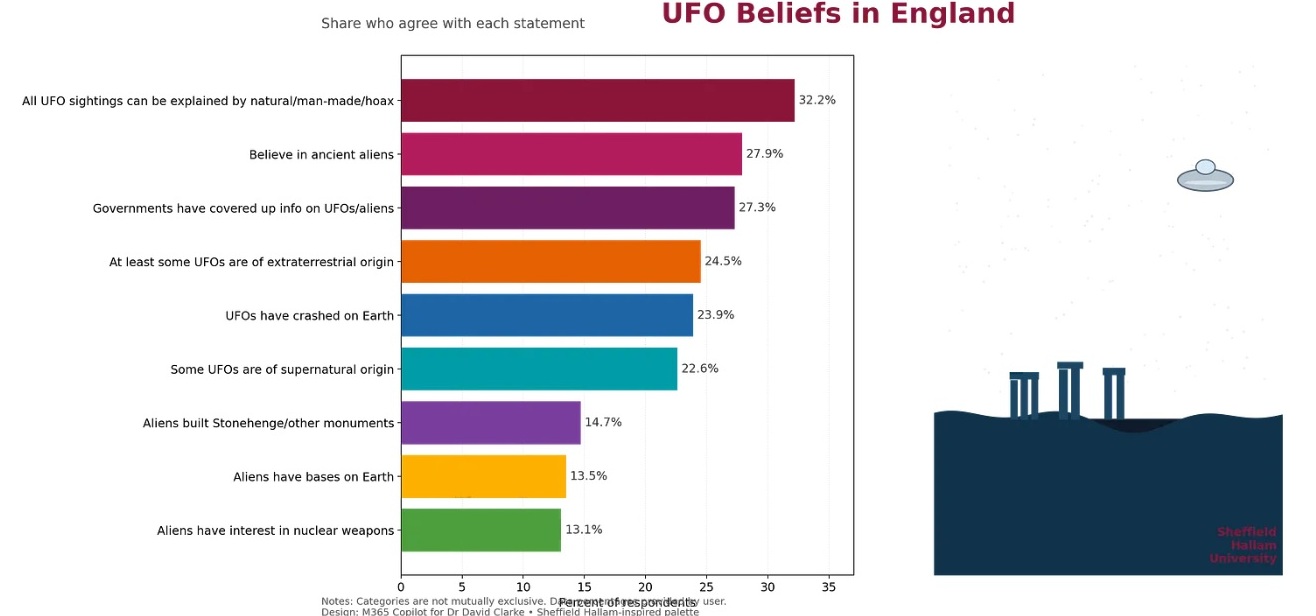
In England, the NFS survey reveals a clear division between believers and sceptics. 32% say they believe all UFO sightings can be explained as natural, man-made phenomena and hoaxes. But nearly a quarter of those surveyed (24.5%) say they believe that at least some UFOs are spaceships controlled by non-human intelligences and 23% say they believe some are visitors from another dimension or even time travellers from our own future. In comparison, the recent YouGov survey in the USA found that 32% believed some UFOs were of extraterrestrial origin.
Indeed, the higher level of reported sightings – and belief in a government cover-up of aliens - in the USA may be linked to the higher level of belief in the extraterrestrial origin of UFOs. As noted by Professor Christopher Bader, sociologist at Chapman University in California, from our survey team:
‘Whether or not aliens are visiting Earth, the first and only requirement for sighting an extraterrestrial craft is belief in their possible existence. A person with a very strong belief in aliens will be more likely to interpret anomalous phenomena in the sky as extraterrestrial in origin. A die-hard sceptic will tend to assume that something they can’t identify has a prosaic explanation.’
- - -
A larger version of this article may be read on Dr. David Clarke’s Substack
The National Folklore Survey website is available at https://www.nationalfolkloresurvey.co.uk/
IPSOS surveyed 1730 people aged between 16 and 75 using their iOmnibus function, a panel that is truly representative of people living in England, considering demographics such as age, education, gender, ethnicity, religion, region and income level. All responses have been anonymised. This type of survey is regularly used by HMG/NHS and other large organisations and the accuracy of the results is regarded with 99% confidence (gold standard).
Featured image: Chart illustrating key UFO results from National Folklore Survey (copyright David Clarke)
