The 2026 Hessdalen Field Trip & Conference brought together researchers and enthusiasts from several countries for three days of presentations, discussion and field investigation in one of Europe's best-known locations for the study of anomalous aerial phenomena.
The event combined a full day of presentations in Trondheim with a field trip to the Hessdalen Valley, providing participants with an opportunity not only to discuss UAP research, but also to visit the locations and instrumentation that have made Hessdalen an important reference point in the history of European UFO research.
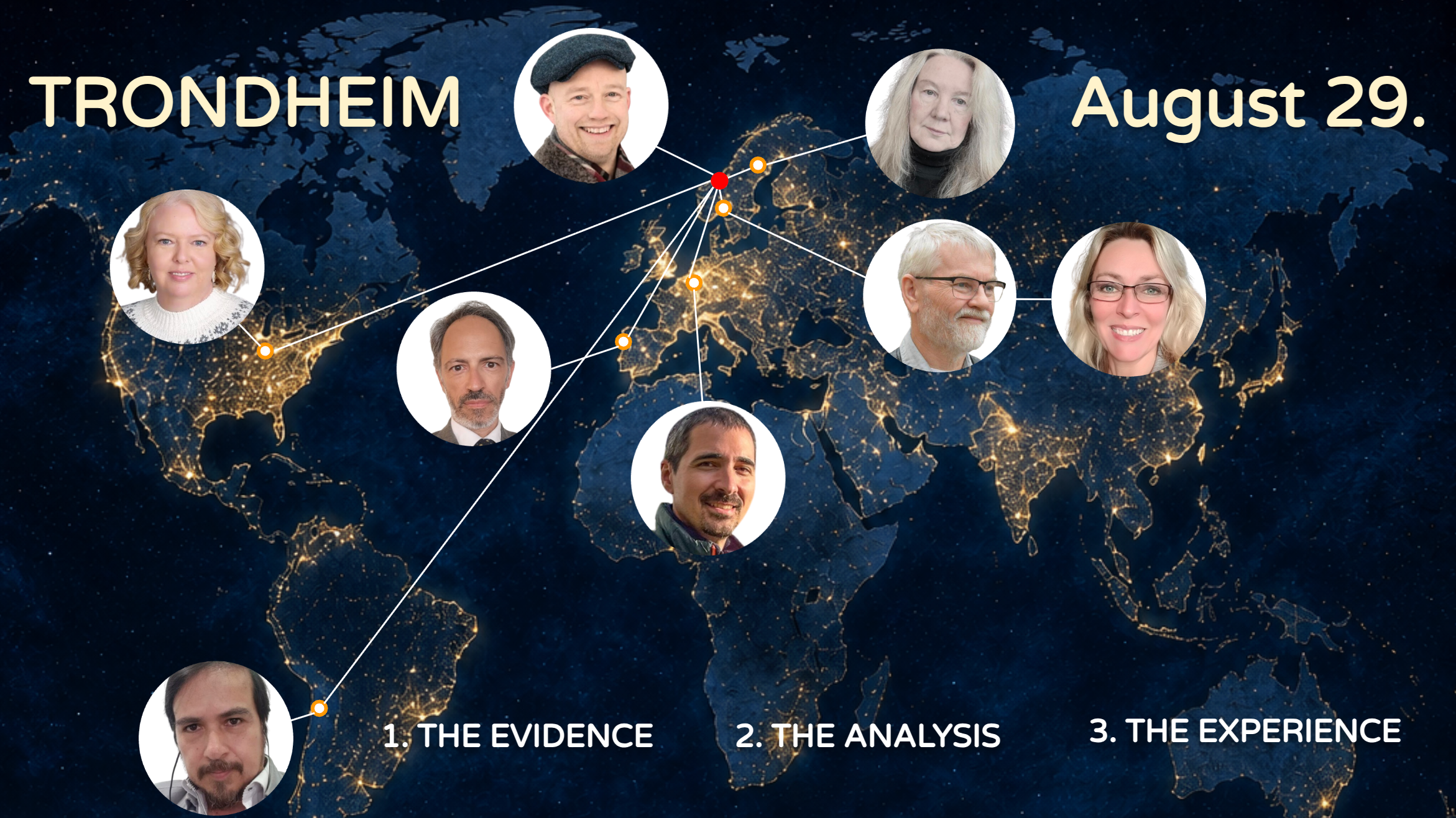
The organizers deliberately structured the conference around three complementary dimensions: science, academic perspectives and personal experience.
The conference opened with Erling P. Strand, one of the founders of Project Hessdalen, who reviewed the history of the project and some of the observations that have been documented in the valley since the beginning of the research programme.
Strand's presentation provided an important historical perspective on an investigation that has continued for more than four decades. The Hessdalen phenomenon became particularly well known following the marked increase in reports between 1981 and 1985, and the first major scientific field investigation was organized in 1984. Project Hessdalen continues today as a citizen-science initiative focused on collecting high-quality data about the phenomenon.
Rainer Haseitl presented the current instrumental activities in Hessdalen, including data-loggers, magnetometers, cameras and other sensors. His presentation illustrated the continuing development of the observation infrastructure and the efforts to improve the automated recording and analysis of possible anomalies.
The work currently being carried out at the Blue Box is particularly significant in this respect. The station, established in 1998, was one of the earliest automated systems designed specifically for the detection and recording of the Hessdalen phenomenon. Project Hessdalen currently uses cameras and other sensors, while additional equipment and detection systems are being developed.
The conference also addressed the phenomenon from perspectives beyond instrumentation.
Håkon Fyhn presented an anthropological approach to encounters with the extraordinary, exploring the relationship between anomalous experiences, culture and interpretation.
Francisco Mourão Corrêa, representing the Society for UAP Studies (SUAPS), presented Epistemology and Scientific Legitimacy, examining different forms of evidence in UAP research and the methodological challenges involved in moving from observation and testimony to evidence, interpretation and scientific knowledge.
The experiential dimension was represented by Anna Scott, Kate Thorvaldsen and Anneli Sarre, who presented different perspectives on personal experiences of contact and their subsequent interpretation. Anna Scott's presentation, From Experiencer to Investigator, was particularly interesting in showing the transition from personal experience towards investigation, while Kate Thorvaldsen and Anneli Sarre contributed their own perspectives on contact experiences.
These presentations highlighted an important characteristic of UAP research: the need to distinguish between the reality and significance of an experience and the conclusions that may subsequently be drawn about its nature or origin.
The international character of the meeting was further reinforced by contributions from researchers working in different countries and with different methodological approaches.
Rodrigo Fuenzalida, director of the Chilean UFO research group AION, presented a selection of cases investigated in Chile and Patagonia, including photographic and video material.
A particularly interesting addition to the programme came at short notice with Artem Bilyk, a professor at a university in Kyiv, Ukraine. Bilyk presented the work of the Ukrainian scientific research centre Zond, devoted to the study of anomalous phenomena.
His presentation described the centre's broad methodological approach, involving a wide range of observational and scientific instruments, including cameras, radiometers, spectrometers, magnetometers, thermal imaging, radio equipment and other sensors. He also presented the centre's approach to the identification and classification of UAP observations.
This contribution provided an interesting example of how UAP-related research is being approached in a very different European context.
The conference was followed by a full field week in Hessdalen Valley.
Participants travelled from Trondheim to Ålen and then continued by bus into the valley, where they visited several locations associated with the Hessdalen research programme. The field trip included the Blue Box and White Box, as well as observation locations throughout the valley.
Rather than simply discussing Hessdalen from a distance, participants were therefore able to see the environment in which the observations occur and the infrastructure used to document them.
The organizers described the field trip as an opportunity to "visit the location, get the stories" and explore the valley together with members of the Project Hessdalen team, local people and other participants.
This transition from conference room to field was perhaps one of the most valuable aspects of the event. It allowed participants to connect historical reports, scientific instrumentation, local geography and personal experience within the same physical environment.
The 2026 gathering also demonstrated the increasingly international character of Hessdalen research.
Project Hessdalen had announced participants and speakers from Norway, Germany, Portugal, the United States, Sweden and Chile, while the last-minute participation of Artem Bilyk added a further Ukrainian perspective.
There was plenty of time for numerous conversations and exchanges between the participants during the conference and field trip. For European UAP research, this kind of informal networking is perhaps as important as the formal presentations themselves. Hessdalen provided an opportunity for researchers working with very different approaches to meet, compare methods and establish new contacts.
More than forty years after the beginning of the Hessdalen investigation, the phenomenon remains unresolved. Yet this unresolved status is precisely what makes the valley an interesting research environment.
The objective of Project Hessdalen is not simply to accumulate stories of unexplained lights, but to collect and preserve data that may allow the observations to be investigated more systematically. Its current programme continues to develop automated observation and recording systems and to make collected material available for further study.
The 2026 conference therefore offered something more than another UFO conference. It brought together instrumental research, academic analysis, case investigation, anthropology and personal experience, followed by direct observation of the environment in which the Hessdalen research takes place.
For those interested in the development of a more rigorous and genuinely international UAP research community, Hessdalen remains a particularly interesting meeting point — both geographically and intellectually.