
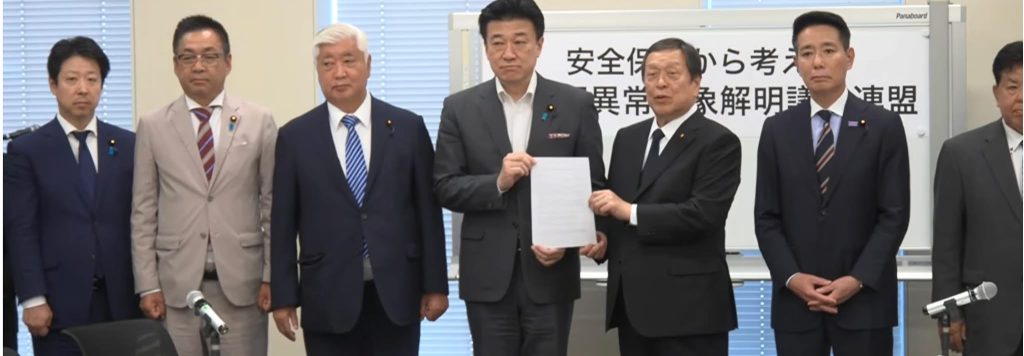
Tokyo, May 28, 2026. Around ten members of the Japanese Parliament's UAP working group met that day with Minoru Kihara, Chief Cabinet Secretary to Prime Minister Sanae Takaichi, to present their recommendations. The event took place a year after the submission of their initial report calling for the creation of a Japanese "UFO Office". The UAP parliamentary working group of the Diet—the Japanese Parliament—is a bipartisan initiative that has grown to about a hundred members since its inception in 2024.
The blueprint presented to the Prime Minister's Cabinet in May 2026 calls for UAPs to be handled as a systemic, state-wide issue of governance and crisis management.
A UFO BUREAU AFFILIATED WITH THE PRIME MINISTER'S CABINET?
Central to these recommendations is the establishment of a centralized command and analytical organ directly tied to the Prime Minister's executive services, the Cabinet Secretariat. The primary objective is to transcend conventional administrative silos and consolidate information streams across ministries, thereby facilitating a swift, coordinated, and scientifically grounded response in the event of an incident. Beneath the surface, a future Japanese UAP "nerve center" is being designed—no longer housed within the Ministry of Defense, but at the very highest level of the Japanese government.
"What we proposed this time is, above all, to strengthen our command function. We believe it is crucial for the Chief Cabinet Secretary to take ownership of the subject and treat the UAP issue with the importance it deserves. This is a major component of our proposal. Without claiming that everything will suddenly change overnight, the Chief Cabinet Secretary indicated that, thanks to the new legal framework for intelligence, the government is now fully equipped to handle this matter properly," stated the Chairman of the UAP parliamentary working group and member of the House of Representatives, Yasukazu Hamada, following this meeting with Minoru Kihara.
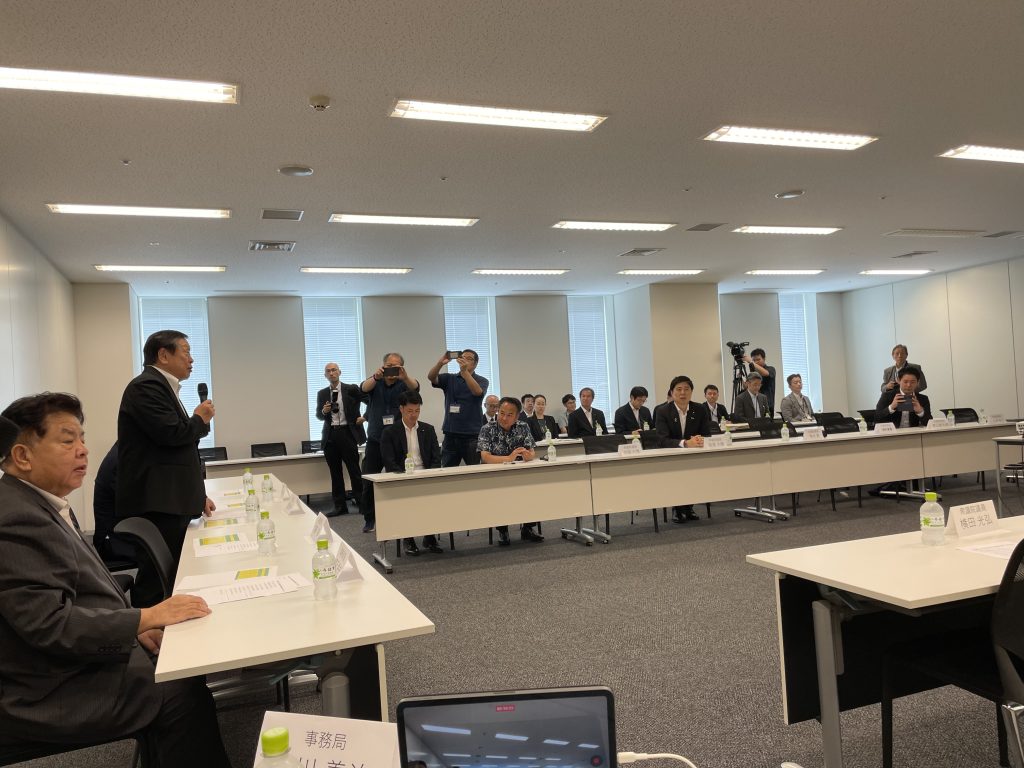
Prime Minister Takaichi's current Chief Cabinet Secretary is a former Minister of Defense, serving between 2023 and 2024. Hamada, incidentally, was also Japan's Minister of Defense from 2008 to 2009, and again from 2022 to 2023... directly preceding Kihara in that role in 2023.
ADVOCATING FOR A NATIONAL SECURITY DOCTRINE ENCOMPASSING UAPs
The lawmakers in the Japanese working group mapped out a second strategic avenue: folding UAPs into a broadened national security doctrine. Taking a cue from the unidentified flying objects that buzzed the Genkai nuclear power plant—a UAP incident that struck southern Japan in July 2025—the lawmakers are urging stronger protections for critical infrastructure. Most importantly, they want to see tighter coordination between defense forces, police, civil aviation, and government authorities. It is a demand that echoes the findings of the deputies from the French Parliamentary Office for Scientific and Technological Assessment (OPECST) following the wave of ‘‘mysterious drones’’ (aka "drovnis") that swept across France from November 2014... right up to March 2015.
Finally, the Japanese lawmakers place heavy emphasis on intelligence gathering and the pressing need to standardize how sightings are reported. By pushing for reliable, secure reporting channels, they aim to empower witnesses—both civilian and military—to speak out and be taken seriously. In Japan, these witnesses faced a stigma even harsher than in Europe or the US. Ultimately, the goal is to break the silence and build upon a database that remains, for now, patchy at best.
"TAKING ACTION WILL BE DIFFICULT AND WILL TAKE TIME"
"Creating a structure from scratch is obviously not easy. However, we cannot afford to do nothing," stressed chairman and House of representatives member’s Hamada. "As members of the National Diet, it is up to us to push the government to act. Since this is a cross-cutting issue, it does not fall under a single entity; we therefore intend to keep working to move things forward, step by step."
"In Japan, the legislative initiative generally belongs to the Cabinet," adds former Japanese Member of the House of representatives Yoshiharu Asakawa, a founding member of this Japanese "UAP Caucus" and now Hamada's special advisor on UAPs. Asakawa warns:"However, if the government remains inactive, members of the Diet can also take legislative action. Thus, if the government ultimately fails to react, our parliamentary group counts many seasoned and experienced lawmakers among its ranks. During previous general assemblies and board meetings, voices have already been raised demanding the implementation of such a system. I am convinced that a decision will be made if nothing changes."
WILL THE FUTURE NATIONAL INTELLIGENCE AGENCY BE THE HUB FOR UAP DATA?
The rollout of a National Intelligence Bureau—essentially a Japanese CIA, greenlit by the Japanese Parliament on May 27, 2026, just a day before the Japanese UAP Caucus sat down with the Prime Minister's Cabinet—unlocks powerful new ways to coordinate and process sighting data. This point was driven home by Representative Gen Nakatani, a two-time Japanese Defense Minister and sitting member of the Parliament's UAP task force. "Data needs to be collected, processed, and put to use in a fully integrated way. Without that, any effective crisis response is simply impossible. In that respect, creating this intelligence agency is a massive leap forward: it will let us pool and analyze all streams of information under one roof. When it comes to UAP incidents, our proposal points out the blind spots in the current Japanese system; centralizing this data will finally allow us to better pinpoint the nature and origin of these phenomena and react as swiftly as possible."
"The unexpected can always happen: missiles, meteorites, or plane crashes. When they do, we have to be ready to respond with speed and precision. Over the last few years, we've seen a surge in attacks involving drones, unmanned aircraft, robots, and other unidentified objects. The government has a duty to grasp the situation, weigh the risks, and act without a moment's hesitation; any delay could result in irreversible damage," Nakatani continued. "That is why it is absolutely vital to look ahead and build a system right now—one that can guarantee a coordinated, seamless response across all our different agencies."
A UAP PARLIAMENTARY GROUP OF OVER 100 LAWMAKERS
The parliamentary working group on UAPs gathers among its roughly one hundred members from both the upper and lower houses of the Japanese Parliament many prominent political figures: former defense ministers, former environment ministers, and even prospective candidates for Prime Minister. Thus, alongside Liberal Democrat Yasukazu Hamada, the chairman of the working group who was twice minister of defense, we also find former Prime Minister and former Japanese Defense Minister Shigeru Ishiba. As well as another former Minister of Defense, Gen Nakatani. "As a founding member of the league, I continue to recognize the strategic importance of UAPs," he stated in May 2025 during the submission of the parliamentary working group's first white paper. Indeed, from September 2024 to October 2025, Gen Nakatani transitioned from the House of Representatives to the government, serving for the second time as Japan's Minister of Defense. "We must maintain comprehensive vigilance at the highest level, regarding any phenomenon that could impact Japan's national security, including those involving unidentified objects."
Officially named the Parliamentary League for UAP Clarification from a Security Perspective, this working group, launched in June 2024, should be considered the Japanese equivalent of the US Congress UAP Caucus, which brings together about fifteen lawmakers. This cross-party initiative, spearheaded in Japan by Yoshiharu Asakawa—a member of the House of Representatives between 2021 and 2024 and the tireless driving force coordinating this task force—aims to encourage the study of UAP phenomena by the Japanese government and assess their national security implications.
"It is essential to close all gaps in our response to these unexplained aerial events."
Yasukazu Hamada, Chairman of the UFO working group, Member of the House of Representatives, and former Japanese Minister of Defense
THE "UFO MEMBER" OF THE JAPANESE PARLIAMENT
"Right from 2020, my very first year as a member of the House of Representatives, I began addressing the UAP issue within the Cabinet Committee. Since 2021, I have also repeatedly directed questions to the Ministers of Defense—Hamada, then Kihara—as well as to other ministers and executive members, totaling dozens of interventions. It was then that two political leaders suggested I create a parliamentary alliance," recounts Yoshiharu Asakawa...
A cute drawing of a flying saucer adorns his business card, hovering above his smiling face. Nicknamed "the UFO Member" within the Japanese Parliament, Asakawa has never made a secret of his interest in UAPs. During the inaugural session of the parliamentary UAP league, he was actually one of two founding lawmakers to openly declare having witnessed a UAP in his youth.
"When I was in junior high school, a black object hovered stationary in the sky above my house for about twenty minutes. I wasn't the only one who saw it. My mother and neighbors were there too. Using a small telescope, we were able to observe it. The object was very large, almost the apparent size of the Moon. At first, it was a single object, but it then gradually split into 4 or 5 pieces," recalls Asakawa. He continues: "It was cubic, completely black, like squares of chocolate... There were small red, green, and yellow lights. It was flying at an estimated altitude of 300 to 400 meters. It made no sound and slowly moved south before disappearing behind the mountains."
"This happened nearly forty-five years ago. Drones didn't exist back then. They weren't balloons either. It was dusk, but the object was completely black," Yoshiharu Asakawa points out. "I didn't initially think it was a UFO. Naively, I imagined back then that UFOs were round and silver, like the ones I had seen on TV."
A WHITE PAPER ON UFOS, FOR A LONG-TERM STRATEGY
Submitting a UAP proposal to the Defense Minister was the parliamentary working group's first objective. This report was provided in May 2025 to Gen Nakatani, the Defense Minister at the time, who, as a parliamentarian, was also one of the founding members of the UAP working group.
"The 2025 report contains three main recommendations," details Yoshiharu Asakawa. "The first is the creation of a Japanese equivalent to the American AARO agency. This service, placed under the authority of the Ministry of Defense, would be tasked with collecting and sharing UAP-related information, and identifying potential threats based on scientific analysis. But it would also guarantee transparency and the dissemination of information to the general public. We also requested that lawmakers receive regular reports on the progress of UAP research."
"The draft report I prepared was adopted almost as is. But this report only scratches the surface of the problem. It is primarily an entry point, intended to get the UAP issue recognized by the authorities," Asakawa specifies. "What is fundamentally required is the implementation of a long-term strategy that extends beyond the exclusive purview of national defense—just like what is being done in the United States."
"We must maintain comprehensive vigilance at the highest level regarding any phenomenon that could impact Japan's national security, including those involving unidentified objects."
Gen Nakatani, Member of the House of Representatives and former Japanese Minister of Defense
THE US MILITARY'S JAPAN FILES?
The parliamentary group is therefore calling for a strengthening of Japan's capabilities to collect and analyze UAP intelligence... while deepening cooperation with the United States. This UAP cooperation between Japanese and American forces became a necessity in 2020, when the Japanese Ministry of Defense ordered the Japan Self-Defense Forces (JSDF) to record and analyze every UAP sighting. "There is close military cooperation between Japan and the United States," confirms Yoshiharu Asakawa. "Now that UAPs have become a major strategic topic for the United States, Japan must also treat them with the same seriousness. Failing to share information that the US considers strategic can only harm us."
It should be noted that since Japan's surrender in 1945, the presence of American military personnel and bases on Japanese soil has led to Japanese UFOs being reported by US soldiers. Project Blue Book thus records 18 UFO sightings that occurred in Japan between 1948 and 1964. Among them is the Fukuoka incident on the evening of October 15, 1948, where a pilot and a radar operator spotted six objects—one of which was visually described as "dark and airship-shaped with a flat bottom and a clipped tail." Another is the sighting of a small, very thin, shiny metallic disk that crossed the path of an AT-6 propeller fighter and an F-84 jet near the Misawa air base on March 29, 1952, at 11:00 a.m.
CONTACTS WITH AARO?
During the 4th general assembly of the Japanese UAP Caucus on March 31, 2026, the main topic of discussion focused on the Japanese information-sharing framework as well as the national security response to be implemented. Senator Kuniko Inoguchi stated:
"Regarding UFOs in the traditional sense (unidentified flying objects), or what are now called UAPs (unidentified anomalous phenomena), we live in an era where devices such as AI-equipped drones are widely used. I therefore believe it is necessary to analyze them from both a criminal investigation and a defense perspective."
"Regardless of whether or not this is directly related to UAPs, as part of our daily measures—particularly against airspace violations—we rigorously analyze the information gathered and strive to make it public," replied Yasuhiro Miyamoto, Senior Advisor at the Joint Staff Office of the Ministry of Defense. The Japanese Ministry of Defense "is in direct contact with the US AARO (All-domain Anomaly Resolution Office), with whom we exchange information and analyses respectively. We intend to continue treating this issue with the utmost seriousness moving forward."
"THERE ARE PHENOMENA THAT ARE NOT OBJECTS"
"I consider the transition from the designation UFO to UAP to represent a significant paradigm shift. It is no longer merely a matter of flying objects; in the modern era, phenomena also exist that do not fly, or which do not constitute objects whatsoever," remarked Senator Seiichi Kushida. He further noted: "Today, emissions can occur in the form of energy without a physical material substrate, and technologies capable of neutralizing drones have been developed in the United States. Moreover, because such occurrences lack physical materiality, they do not technically constitute an airspace violation. Unless we redefine the concept of airspace violation, Japan will fail to secure its own defense. Given the expansive definition of UAPs, the conventional categories utilized hitherto are no longer applicable."
HEARINGS OPEN TO "FOREIGN" EXPERIENCES
Throughout 2025 and 2026, the UAP working group also gave the floor to international speakers. The 2nd general assembly, on March 28, 2025, focused on American disclosure with the participation of four influential figures: former Deputy Assistant Secretary of Defense for Intelligence Christopher Mellon; Tim Gallaudet, former US Navy Rear Admiral and former Assistant Administrator of NOAA, the US oceanic and atmospheric agency; and anthropologist Peter Skafish, co-founder of the Sol Foundation. Not to mention Republican Representative Eric Burlison from the US House of Representatives.
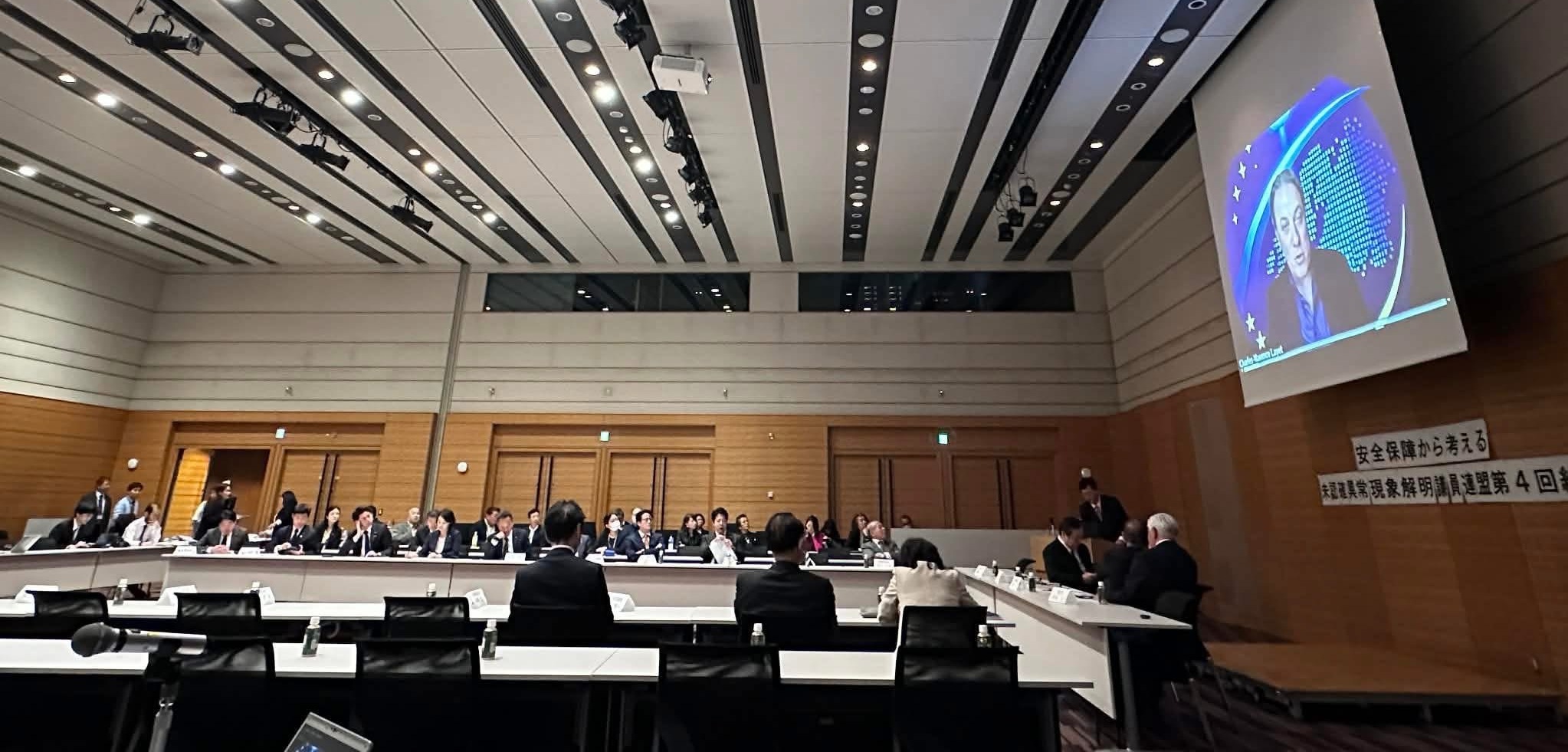
The parliamentary UAP group invited me to participate on March 31, 2026, in their 4th discussion, via a roughly ten-minute presentation on the UFO situation in Europe in 2025. [see featured image, on top of page] I recalled the 5,000 sightings recorded in 2024 by the 23 organizations of the "Euro UFO Barometer" network, figures unveiled by Frenchman Philippe Ailleris of the European Space Agency (ESA) in December 2025 via UAPCheck and the EuroUfo network. I touched upon the German and Dutch authorities now being favorable to reporting UAP encounters in the skies, as well as the support of the European Space Agency (ESA) for European Union scientific research on UAPs. I also mentioned various academic initiatives in Sweden, Germany, and Great Britain concerning research and educational programs on UAPs, UFOs, and non-human intelligences (NHI). Furthermore, I adressed the alert regarding the "drovnis" (drone-UFOs) observed over Denmark, Sweden, Norway... as well as Germany, France, and Ireland, between September and December 2025.
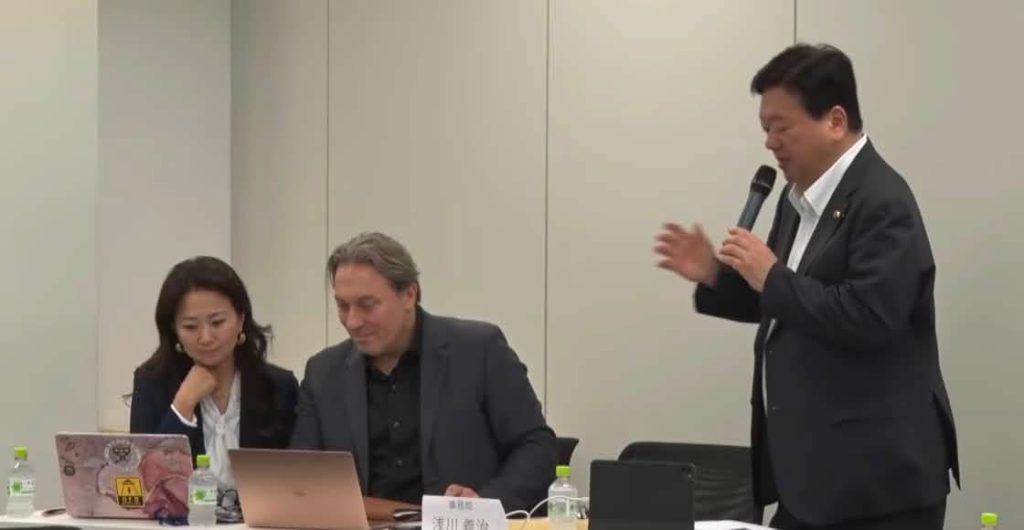
At the fifth general assembly on July 14, 2026, I had the chance to take the floor once again—this time in person—to brief the Japanese lawmakers on the key highlights of the June 29, 2026 UAP symposium, co-organized just two weeks earlier by French deputies Pierre Henriet and Arnaud Saint-Martin inside the National Assembly.
ADDITIONAL LAWMAKERS TESTIFY UFO SIGHTINGS!
The debates at this fifth general assembly of the parliamentary UAP working group primarily focused on the disclosure situation driven by Trump and the White House, through the releases of Operation PURSUE. By mid-July 2026, its website had surpassed two billion views since May. Numerous high-ranking civil servants were also in attendance, invited regarding the incident above the Genkai nuclear power plant, which was overflown in July 2025 by three mysterious lights. But the evasive, bureaucratic non-answers from the Japanese police and nuclear safety authorities left the lawmakers furious. Outraged by the officials' stonewalling, UAP working group chair Hamada abruptly cut the meeting short.
During this session, two new representatives also testified about their UFO observations. A young female member, recalling her experience as a child, asked the police representative what she could do with such reports. Yuzo Yamamoto, another Liberal Democratic Party representative attending for the first time, used his floor time to reveal his personal experience. "When I was in middle school, one evening while I was on a train, I observed something that still defies all explanation. The object was moving laterally at an incredible speed in a straight line, stopped dead, then shot vertically upward before heading off to the side again... repeating this pattern. It lasted for about 15 seconds," recounted the new member of the House of Representatives. "Even today, I find it profoundly mysterious."
That brings the total to four members of the parliamentary UAP task force who have now publicly admitted to seeing UAPs—up from just two. For three of them, the encounters happened when they were kids.
UAP HAVE BECOME AN "ACTIVE" POLITICAL ISSUE IN JAPAN
Through these recommendations and public statements, a strategic repositioning is beginning in Japan: moving from a passive, cautious, and indirect posture to an active and integrated political approach. Here, UAPs are becoming a coordinated subject interwoven across defense, intelligence, science, and governance. It is also about bridging and connecting observations from citizens and official agencies alike, as Yoshiharu Asakawa points out: "There are areas where the boundary between national security and crisis management is not clearly defined, and where these two domains must necessarily overlap. In this context, faced with the sudden appearance of an unidentified phenomenon or object—potentially a drone—it seems crucial to me to integrate information gathering from the private sector."
This evolution in political awareness positions Japan halfway between the American approach, dominated by military secrecy and "controlled disclosure" under the aegis of the Pentagon, and the European approach, championed by civil society, the ufological community, and European parliamentarians since the 1990s. In France, this is embodied by GEIPAN, an organization that will celebrate its fiftieth anniversary in 2027 and was honored on June 29, 2026, during the UAP symposium held at the French National Assembly.