
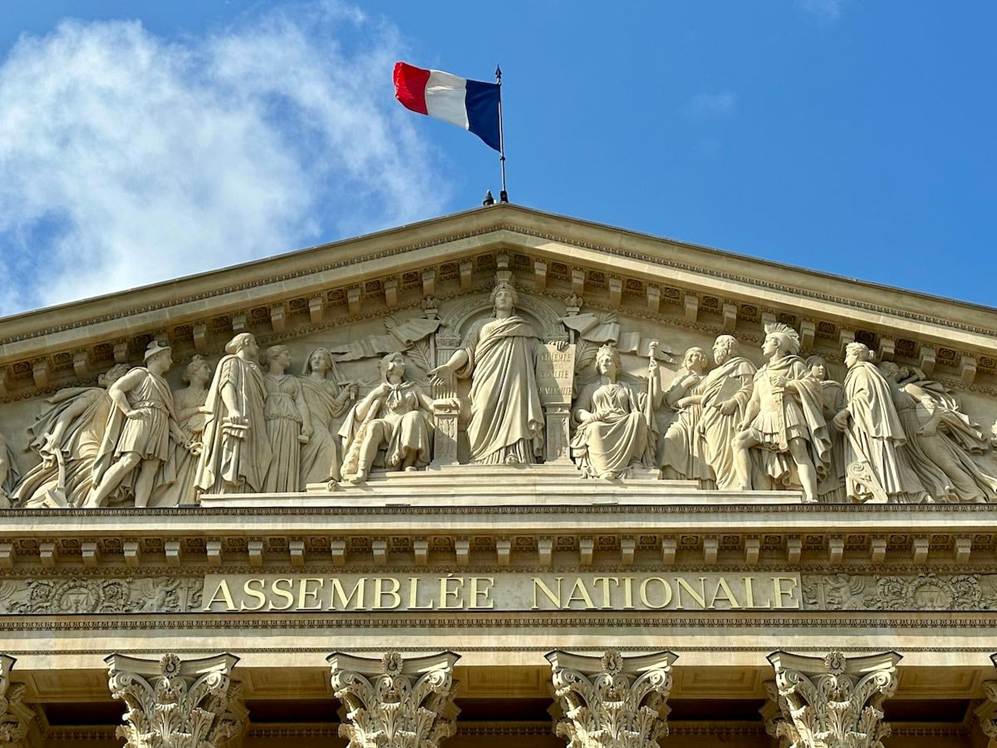
On June 29th 2026, the French National Assembly is expected to host a public parliamentary colloquium in Paris under the title La recherche sur les phénomènes aérospatiaux non identifiés au-delà des fantasmes (Research on Unidentified Aerospace Phenomena Beyond Fantasy). The event is co-organized by Arnaud Saint-Martin, deputy for Seine-et-Marne from La France insoumise - Nouveau Front Populaire, and Pierre Henriet, deputy for Vendée from Horizons & Indépendants. The venue reported by parliamentary and press sources is Victor-Hugo Hall, inside the Assemblée nationale. [1][2][3][5][6]
The subject is unusual for a parliamentary venue. It is also not new to France. Since 1977, the country has maintained an official institutional path for the collection and analysis of reports of phénomènes aérospatiaux non identifiés, the French equivalent to nowadays Unidentified Aerial Phenomena (UAP). That history began with a dedicated a specialized service within CNES, the French space agency, first called GEPAN, then SEPRA, now GEIPAN (Groupe d'Études et d'Informations sur les phénomènes aérospatiaux non identifies). [9][10]
The colloquium title clearly shows its intended tone: beyond fantasy. Early press coverage and statements from the organizers point toward a sober framing: not an exercise in spectacular disclosure, but a sober discussion about research, institutional methods, evidence, public responsibility and the conditions under which this topic can be handled rationally. Pierre Henriet told LCP that the aim is to show that these phenomena can be worked on rationally and to highlight the work of experts, rather than cultivate the impression that hidden secrets are being withheld. [1][2][4]
The program reproduced below is based on the preliminary information currently circulating and included in the document. It is listing announced speakers, not the complete list of guests or attendees. Several details may still be updated by the organizers before the event. [5][6][7][8][44]
What is known at this stage
The following points are currently the most stable public information about the event. [1][2][3][5][6][7][8]
| Element | Preliminary information |
|---|---|
| Date | 29 June 2026 [1][2][3] |
| Place | French National Assembly, Paris [1][2][3] |
| Room | Salle Victor-Hugo, reported by LCP and visible on the preliminary program [1][7][8] |
| Reported schedule | The flyer lists three roundtables from 15:10 to 18:40, LCP gives a broader 15:00-19:00 slot, Le Parisien reported 15:00-18:30. [1][2][7][8] |
| French title | La recherche sur les phénomènes aérospatiaux non identifiés au-delà des fantasmes |
| English rendering | Research on Unidentified Aerospace Phenomena Beyond Fantasy |
| Organizers | Arnaud Saint-Martin and Pierre Henriet [1][2][3] |
| Institutional support shown | The preliminary visual displays support from GEIPAN, public reporting also describes GEIPAN/CNES involvement. |
| Program status | Preliminary program circulated online and privately, a final official text program may still amend titles, affiliations or timing. [5][6][7][8] |
Preliminary program: three roundtables
The preliminary program currently in circulation is structured around three roundtables. The first places UAP research in a historical and contemporary perspective. The second focuses on official French work by GEIPAN and the French Air and Space Force. The third broadens the discussion toward public authorities and international responses, including the comparison between GEIPAN and the Pentagon. [7][8]
Introduction and conclusion will be by Arnaud Saint-Martin and Pierre Henriet. The program is visually using the French acronym PAN, while this article also uses UAP for international readers.
| Time | Session | Theme | Announced speakers |
|---|---|---|---|
| 15:10-16:15 | Roundtable 1 | Research on PAN: history and contemporary issues | Pierre Lagrange, Dominique Pinsolle, Luc Dini [7][8] |
| 16:15-17:25 | Roundtable 2 | Official work on UAP by GEIPAN and the French Air and Space Force | Frédéric Courtade, Mathieu Courtaban, Jérémy Moyal, Gilles Munsch, Michaël Vaillant [7][8] |
| 17:40-18:40 | Roundtable 3 | From GEIPAN to the Pentagon: current affairs and responses from public authorities | Philippe Ailleris, Sylvain Maisonneuve, Baptiste Friscourt [7][8] |
| Opening and closing | Organizers | Introduction and conclusion | Arnaud Saint-Martin, Pierre Henriet |
France has a distinctive institutional history on UAP
For international readers, the French setting is essential. France is the only country in the world which has kept a public-facing structure within a national space agency, devoted to the collection and analysis of unidentified aerospace phenomena reports for nearly four decades. The current GEIPAN page of CNES describes its mission as collecting, analyzing and archiving UAP reports while informing the public. It also gives the institutional timeline: GEPAN was created in 1977, it was replaced by SEPRA in 1988, and GEIPAN replaced SEPRA in 2005. [9][10]
This history does not mean that the subject is simple or uncontested. It means that France has been holding a long administrative and methodological history that is unique worldwide. GEIPAN is receiving reports, working with witnesses and partner institutions, publishing sighting reports and classifying cases according to the quality of available data and the probability of identification/explanation. Its mere existence is offering a public point of reference for a topic that elsewhere is often fragmented between private researchers, military channels, intelligence procedures, journalists and advocacy groups. [9][10]
The June 29th colloquium therefore has two layers. On the surface, it is a public event about a controversial subject. More deeply, it is a test of whether France's official experience, academic work, military interfaces and civil-society initiatives can be discussed together inside a parliamentary setting without reducing the subject to either belief or ridicule.
Those chosen words in the title, “Beyond Fantasy”, are important in that respect. It acknowledges the cultural weight of UFO narratives while refusing to let that cultural weight define the entire field. UAP reports can involve ordinary misidentifications, unusual atmospheric phenomena, human-made objects, sensor artifacts, rare events, incomplete data, and some cases that resist any classification. A serious public framework does not require extraordinary conclusions: it requires traceable data, methodological discipline and a willingness to keep questions open when the evidence is insufficient.
From GEIPAN to the Pentagon — and back
The colloquium also takes place in an international context reshaped by the United States. Since 2017, UAP have become a recurring subject in the U.S. political and media environment, with congressional hearings, official reporting requirements, declassified videos, and the creation of dedicated government structures such as the All-domain Anomaly Resolution Office (AARO) inside the Department of Defense. Whatever you may think of the ongoing debate in the USA, it has made the topic more visible and more politically legitimate than it was a decade ago. [22][17][18]
Since the 2017 revelations about a Pentagon-funded UFO/UAP project, the United States have gradually moved the topic into a more formal public and institutional framework. The Congress imposed UAP reporting requirements, AARO was established in 2022 to centralize the collection and analysis of UAP reports, NASA launched an independent UAP study in 2022 and released its report in 2023, and the FY2024 National Defense Authorization Act created a public UAP records-collection process at the National Archives. More recently, the publication of official UAP images and reports on AARO’s website has added a concrete public-facing dimension to this process. [22][18][19][20][21][17]
France and the United States offer different institutional models. The U.S. model is heavily shaped by national security, military reporting, intelligence oversight and the politics of disclosure. The French model, is more public-facing and historically connected to the national space agency, civil reporting channels and technical investigation. This does not automatically make one model better than the other: it makes their comparison useful. GEIPAN has developed a specific culture of investigation, assessment and qualification of anomalous reports. Its work is not only to collect cases, but also to build reliable databases of reports concerning unknown or insufficiently explained phenomena, using trained investigators and expert networks to clarify the limits of what can be established, what remains uncertain, and what should not be asserted from the available evidence. [9][17][23]
The third roundtable’s title, “From GEIPAN to the Pentagon,” points exactly to that comparison. Yet the comparison also works in the opposite direction: from the Pentagon back to GEIPAN. The American trajectory has created a powerful international effect of political and media amplification, while the French trajectory offers a longer-standing public investigation model. Taken together, those two examples raise a shared question: how can public authorities produce reliable knowledge on UAP while balancing science policy, military risk, public information, secrecy, transparency, data quality and democratic oversight?
Organizers and announced speakers
The following biographies combine the roles shown on the preliminary program with publicly available institutional or professional information.
Organizers and Hosts
Arnaud Saint-Martin
Co-organizer, deputy for Seine-et-Marne, La France insoumise - Nouveau Front Populaire
Arnaud Saint-Martin is a deputy for the 1st constituency of Seine-et-Marne and a sociologist of science and technology. Before entering Parliament in 2024, he was a CNRS research fellow — Centre national de la recherche scientifique, France’s main public research organization — whose work focused on the sociology and history of science and technology, with particular attention to space activities, astronomy, space policy and the cultural and political imaginaries attached to space exploration. At the National Assembly, he is a member of the Commission de la défense nationale et des forces armées, a member of OPECST — the Office parlementaire d’évaluation des choix scientifiques et technologiques, or Parliamentary Office for the Evaluation of Scientific and Technological Choices — and vice-president of the parliamentary study group on Aeronautics and Space. [11][13][14][15]
His combined background as a parliamentarian and sociologist of science is central to the framing of the colloquium. It allows UAP to be approached not only as reported phenomena, but also as objects of public knowledge, scientific controversy, institutional treatment, technical expertise and democratic responsibility. His experience in science and technology studies gives him a particularly sharp understanding of the difficulties raised by this topic: evidence, expertise, credibility, public communication, institutional trust and the boundary between serious inquiry and sensationalism.
Pierre Henriet
Co-organizer, deputy for Vendée, Horizons & Indépendants
Pierre Henriet is a deputy for the 5th constituency of Vendée, a member of the Horizons & Indépendants group, and Secretary of the French National Assembly. He is currently First Vice-President of OPECST — the Office parlementaire d’évaluation des choix scientifiques et technologiques. Trained as a secondary-school mathematics teacher, he also has an academic background in philosophy of science and epistemology. [12][13][14]
His involvement gives the colloquium a cross-party and science-policy dimension. Having chaired OPECST from 2022 to 2023, and now serving as its First Vice-President, he brings parliamentary experience at the interface between scientific expertise, technological choices and public decision-making. In public comments reported by LCP, he framed the event as an effort to show that the subject can be addressed rationally and through expert work, rather than through speculation or sensationalism. [1]
Round table 1 - Research on PAN: history and contemporary issues
Pierre Lagrange
Anthropologist of science, EHESS (School for Advanced Studies in the Social Sciences)
Pierre Lagrange is a French sociologist and anthropologist of science, known for his work on controversies, parasciences, UFOs, paranormal claims and the boundaries between science, belief, evidence and public culture. He worked for several years at the Centre de Sociologie de l’Innovation at Mines Paris, in the intellectual environment associated with the sociology of science and technology, and later pursued research in anthropology and the sociology of culture. [24]
Since the 1980s, Lagrange has studied the UFO field not primarily as a matter of belief, but as a social, historical and epistemological object: how witnesses, investigators, skeptics, institutions, scientists and the media negotiate the status of anomalous claims. His major books include La Rumeur de Roswell (1996), a sociological study of the Roswell controversy, La Guerre des mondes a-t-elle eu lieu ? (2005), which revisits the myth of mass panic around Orson Welles’ 1938 radio broadcast, and Ovnis: ce qu’ils ne veulent pas que vous sachiez (2007), devoted to conspiracy narratives, secrecy and the public construction of UFO controversies. His presence in the first roundtable brings a long-term historical and anthropological perspective on the construction of the UFO/UAP controversy in France and abroad. [24][25][26]
Dominique Pinsolle
Historian, Université Bordeaux Montaigne CEMMC (Contemporary History)
Dominique Pinsolle is a maître de conférences in contemporary history at Université Bordeaux Montaigne, attached to the CEMMC — Centre d’Études des Mondes Moderne et Contemporain. He holds an habilitation à diriger des recherches, completed in 2024, and works on communication, trade unionism, sabotage, media history and modern and contemporary political cultures. [27]
His work on the press, communication, social conflict and technical democracy provides a useful historical perspective on how public controversies are constructed. The UAP question has also been shaped by media narratives, archives, official statements or silences, public expectations and changing communication environments.
Luc Dini
Aerospace and defence engineer at Thales, President of 3AF’s SIGMA2 commission
Luc Dini is an aerospace and defense engineer with long professional experience in aeronautics, space and defense, including missile defense, air defense, electronic warfare, surveillance systems, large systems engineering and international business development. His career includes work for the French defense sector, Thomson-CSF and Thales Air Systems, where he held senior positions in systems, strategy and missile defense business development. [28]
Within the Association Aéronautique et Astronautique de France (3AF), he became president of SIGMA2 technical commission from 2013 onward. SIGMA2 is focusing on the technical study of UAP cases, especially “hard observables” such as physical traces, radar data, sensor information and aerospace-related evidence. The commission has produced comprehensive technical and activity reports, and Dini’s presence brings an aerospace and defense-engineering perspective to the discussion, complementing the historical and social-science approaches. [28]
Round table 2 - Official work on UAP by GEIPAN and the French Air and Space Force
Frédéric Courtade
Engineer, director of GEIPAN, CNES
Frédéric Courtade has been head of GEIPAN since 2024. A graduate in materials science, he has followed both a technical and managerial career at CNES, including twenty years of expertise and investigation on space hardware within the CNES expert laboratory, five years on the development of scientific instruments for planetology and exobiology, and four years managing the service responsible for space mechanisms and satellite attitude-control equipment. [9][10]
At GEIPAN, his role is not only to manage a team composed of CNES staff and committed volunteers, but also to maintain a rigorous and transparent working method. His public position is emphasizing technical and scientific demonstrability, methodological robustness, respect for witnesses, and public access to investigation results. His participation places the second roundtable in the practical context of GEIPAN’s current work: case collection, investigation, classification, expert review, coordination with the institutional stakeholders (both military and scientific representatives), public information and the long-term archive of French UAP observation. [9]
Mathieu Courtaban
Representative of CAPCODA (Centre for Planning and Conducting Air Defense Operations)
Mathieu Courtadon is listed in the preliminary program within the second roundtable on official work by GEIPAN and the French Air and Space Force, with an affiliation to CAPCODA. The CAPCODA is the French Air and Space Force’s Air Centre for Planning and Conducting Air Defense Operations, based at Lyon-Mont Verdun Air Base. It operates within the CDAOA framework and was created from the merger of the Centre national des opérations aériennes (CNOA) and the Centre Air de Planification et de Conduite des Opérations (CAPCO). [29]
His announced presence indicates the inclusion of an operational airspace and air-defense perspective. This is important because some UAP questions involve not only scientific interpretation, but also air safety, reporting chains, sensor data, controlled airspace and the operational handling of unusual observations.
Jérémy Moyal
Representative of Armée de l’Air et de l’Espace (French Air and Space Force)
Jérémy Moyal is listed in the preliminary program as representing the French Air and Space Force. The available information identifies him as an active officer in the Armée de l’Air et de l’Espace. This is the French Air and Space Force. It is responsible for French air and space operations, including airspace sovereignty, permanent air-security posture, air operations planning and, since the creation of the Commandement de l’Espace, the integration of military space responsibilities into the air force structure. [30]
His presence situates the second roundtable at the interface between civilian reporting, official investigation and military airspace awareness. For the public, that matters because the UAP topic can involve operational reporting, aviation safety, pilots, crews, radar or sensor information, and the protection of controlled airspace.
Gilles Munsch
GEIPAN investigator & expert (Field Investigation), SCEAU and CNEGU member
Gilles Munsch is listed as a GEIPAN expert and investigator. A retired mechanical engineering teacher, he has been involved for decades in field investigation, case documentation and French UFO research networks, including organizations such as CVLDLN, CNEGU, SERPAN and SCEAU, as well as an investigator for GEIPAN. [31][32]
His expertise lies in long-term field investigation and the practical assessment of reports, having covered hundreds of cases over several decades. His participation brings a methodological and investigative perspective: how reports are documented, what makes a case usable or unusable, how expert networks contribute to interpretation, and why “unexplained” often means that evidence remains incomplete rather than that a conclusion has been reached.
Michaël Vaillant
Meta-Connexions founder, Data-Scientist, GEIPAN expert and president of UAP Check
Michaël Vaillant is a data scientist, a GEIPAN expert for nearly twenty years, and the founder of Meta-Connexions, created in 2006, as well as founder/president of UAP Check international initiative in 2023. He holds a Master’s degree in Innovation Management and a Master’s degree in Information Systems Architecture. His work has long been focusing on the structuring, analysis and interoperability of UAP-related data, with a special attention to traceability, methodological robustness, database architecture and the conditions required for cumulative scientific investigation. [33][34][35]
Since 2006, through his work with GEIPAN, he has contributed to the development of the service’s institutional website and UAP database, and developed software tools designed to support methodological case analysis while reducing investigative bias. Since 2023, through UAP Check, he has focused on strengthening international cooperation and promoting good practices for reliable science: robust data, traceability, shared standards, interoperable data services, and responsible access to institutional knowledge. He also serves on the Board of Advisors of SUAPS, the Society for UAP Studies. [9][36][37]
Round table 3 - From GEIPAN to the Pentagon: current affairs and responses from public authorities
Philippe Ailleris
Senior Project Controller at the European Space Agency
Philippe Ailleris is a Senior Project Controller at the European Space Agency, where he has worked for more than twenty-eight years. His professional background is in project control, cost planning, financial monitoring, risk management and programme reporting within the European space sector, including Copernicus Sentinel-related projects.
Alongside his ESA career, he has been active for many years in the UAP field, with a particular interest in observation standards, witness reporting, structured data collection and the scientific documentation of unusual aerospace observations. His presence in the third roundtable connects the French discussion to broader international efforts to improve UAP reporting, observation protocols and data quality. [38][39]
Sylvain Maisonneuve
Director of Strategy at Prosol, Former ministerial adviser, author
Sylvain Maisonneuve is a former lawyer and former ministerial adviser. Trained in public law, with postgraduate degrees in public contracts and public law, he worked in law firms before holding advisory roles in the French economic and financial ministries, notably on commerce, retail, consumer affairs, companies, crafts, hospitality, events and market services. He is currently Director of Strategy at Prosol. [40]
He is the author of the recent book Ovnis, l’enquête déclassifiée, devoted to UAP, declassified material, the Pentagon, congressional pressure for transparency and the institutional handling of the subject. His presence in the third roundtable is consistent with a discussion of how public authorities respond to UAP questions beyond technical case analysis, including secrecy, crisis management, public communication, democratic oversight and access to information. [40]
Baptiste Friscourt
Secondary-school teacher, Sentinel News author, correspondent for The Debrief
Baptiste Friscourt is a visual arts teacher in secondary education. He holds a Diplôme national d’arts plastiques from the École nationale supérieure des beaux-arts and is currently studying Information and Communication Science at Université Bourgogne Europe. [41][42][43]
Alongside these activities, he follows UAP news and has been an active podcaster since 2020, later through the French online channel Sentinel News, where he provides regular coverage of UAP-related developments in France and abroad, and is French correspondent for science, tech, and defense news website The Debrief.
A Public Parliamentary First for UAP Science & Investigation in France
The main significance of June 29th colloquium does not lie only in the topic itself, but in its setting: a parliamentary venue, a cross-party initiative, the presence of official French actors, historians, social scientists, data specialists, specialist media contributors and civil-society representatives, and a public-facing format. France has already addressed unidentified or poorly identified aerial events in parliamentary settings, but this colloquium appears to mark a new threshold: an open parliamentary event explicitly devoted to UAP research, beyond fantasy, with the subject named directly and without ambiguity. [1][2][3][16]
For decades, UAP have often been caught between two unhelpful extremes. On one side, ridicule and stigma are discouraging witnesses, pilots, researchers and institutions from speaking clearly. On the other side, sensational narratives can move faster than evidence. A parliamentary colloquium like this can create an opportunity to shift the centre of gravity: from belief to method, from secrecy to responsible access, from isolated initiatives to cumulative knowledge, and from national silos to interoperable international frameworks.
The event also raises a practical question beyond France. GEIPAN is a distinctive institutional feature of the French approach, but a small official service cannot create an entire scientific field by itself. Serious progress requires better data architecture, standardized reporting, cooperation with military and civil aviation channels, open scientific protocols, academic engagement and international exchange. This colloquium may become important if it leads to sustained work after the event: hearings, parliamentary follow-up, improved access to data, clearer institutional responsibilities or renewed scientific partnerships. [9][10]
2014 OPECST Drone Hearings as an echo
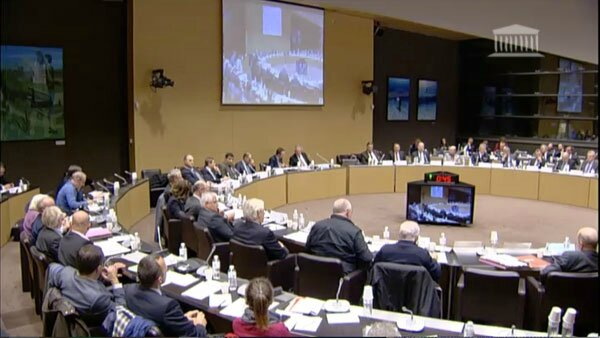
In November 2014, OPECST — the Office parlementaire d’évaluation des choix scientifiques et technologiques — held hearings on the overflight of French nuclear facilities by unidentified drones. As a joint body of the French National Assembly and Senate, OPECST is tasked with informing Parliament about the consequences of scientific and technological choices. The 2014 drone case was not framed as a classical UAP problematic even if it connect directly to it as it raised several questions directly relevant to the public treatment of unidentified aerial events: how to investigate objects that are reported but poorly documented, how to balance public information with security constraints, how to coordinate multiple state services, and how to develop detection and response capabilities when the phenomena do not fit existing operational categories.. [16][13]
The 2014 hearings showed that unidentified aerial events can become public-policy issues when they occur at the intersection of sensitive infrastructure, defense, public concern and technological uncertainty. They also highlighted a recurring institutional difficulty: when an aerial phenomenon is observed, reported or inferred, but not clearly identified, responsibility may become fragmented between security, safety, military, scientific, technical and political actors. In that sense, the 2026 colloquium is not isolated. It belongs to a longer French parliamentary history of trying to address unidentified aerial events through inquiry, expertise, public accountability and institutional coordination. [16]
This comparison has its limits, of course. The 2014 case concerned drones over nuclear installations, while the 2026 colloquium is concerning UAP research more broadly. But the common issue is methodological and institutional. In both cases, public authorities face aerial reports that require documentation, cross-checking, sensor analysis, witness assessment, operational coordination and careful communication. The question is not only what the objects are, but how a democratic state can organize knowledge when unidentified aerial events are raising public, scientific and security concerns at the same time. [16]
UAP Check’s role: verification, context and international circulation
UAP Check operates as a network of contributors and organizations at the international level. Our value lies in connecting actors, documenting the field, supporting standards and making information available across languages. [33][45]
For an international audience, a French parliamentary colloquium on UAP can be difficult to interpret. The French terminology differs from the English one. The institutional history is specific. GEIPAN has no exact equivalent in other countries. The political setting - a cross-party initiative inside the National Assembly - also deserves a careful explanation. UAP Check can help bridge that gap by providing a verified, multilingual, contextual source for journalists, researchers, institutions and the interested public. [9][13]
The central issue is not whether one more UAP event takes place. It is whether the subject can be structured as a durable field of inquiry. That requires more than individual visibility. It requires shared methods, traceable data, cautious language, open correction, institutional memory and the capacity to collaborate across national and professional boundaries.
Editor’s note
This article is based on publicly available information and on the preliminary program currently circulating as of May 31, 2026. Since the event is scheduled for a future date and a different final official program may be issued, affiliations, time slots and speaker titles may be updated later on. [5][6][7][8][1][2][3]
If an organizer, speaker or institution mentioned here wishes to provide a correction, confirmation or updated title, UAP Check will amend the article accordingly, update it as new information becomes available, and record the date of each correction or substantive update. The purpose is to maintain a public reference page that remains useful, accurate and transparent over time.
References and source links
The following reference table consolidates the links used or discussed while preparing this public-information article. In-text bracketed numbers refer to the numbered sources below.
[1] LCP — Les Ovnis s’invitent à l’Assemblée le temps d’un colloque inédit. Parliamentary media report on event, venue, organizers and framing.
[2] Le Parisien — “Sortir du sensationnalisme”: les ovnis à l’affiche d’un colloque inédit à l’Assemblée nationale. Mainstream press preview and timing information.
[3] La Dépêche du Midi — OVNI: le 29 juin, un colloque public organisé à l’Assemblée nationale. Regional press coverage.
[4] La Dépêche du Midi — Editorial: OVNI, sciences et fantasmes. Editorial framing of science and public debate.
[5] Arnaud Saint-Martin — LinkedIn announcement of the colloquium. Organizer’s public announcement.
[6] Arnaud Saint-Martin — LinkedIn registration / colloquium information post. Registration and practical information.
[7] Facebook — public post displaying the preliminary programme visual. Public trace of the programme visual.
[8] Instagram — preliminary programme / visual post. Preliminary programme visual.
[9] GEIPAN — official website. Official French public body for PAN reports.
[10] CNES — GEIPAN project page. CNES institutional context for GEIPAN.
[11] Assemblée nationale — Arnaud Saint-Martin official profile. Official parliamentary profile and functions.
[12] Assemblée nationale — Pierre Henriet official profile. Official parliamentary profile and functions.
[13] Assemblée nationale — OPECST official presentation. Role of OPECST.
[14] Assemblée nationale — OPECST composition. Current OPECST membership and officers.
[15] Assemblée nationale — Parliamentary study group on aeronautics and space. Parliamentary study-group context.
[16] Sénat / OPECST — Les drones et la sécurité des installations nucléaires, report no. 267 (2014-2015). 2014 parliamentary precedent on unidentified drones and sensitive infrastructure.
[17] AARO — Official UAP imagery. Official UAP imagery and case material.
[18] U.S. Department of Defense — Establishment of AARO. Creation of AARO in 2022.
[19] NASA — NASA Issues Report on Unidentified Anomalous Phenomena. NASA UAP independent study report release, 2023.
[20] NASA — UAP Independent Study Team Final Report. Final report PDF.
[21] U.S. National Archives — Unidentified Anomalous Phenomena Records Collection. Public UAP records collection process.
[22] The New York Times — Glowing Auras and “Black Money”: The Pentagon’s Mysterious U.F.O. Program. 2017 turning point in U.S. public debate.
[23] AARO — Report on the Historical Record of U.S. Government Involvement with UAP, Volume I. AARO historical report.
[24] Pierre Lagrange — biographical and bibliographical overview. Summary of career and publications.
[25] La Rumeur de Roswell — bibliographical reference in the Roswell entry. Reference for Lagrange’s book on Roswell.
[26] La Guerre des mondes (radio, 1938) — context for Lagrange’s book on the alleged panic. Context for Lagrange’s work on Orson Welles.
[27] Université Bordeaux Montaigne / CEMMC — Dominique Pinsolle profile. Academic affiliation and research profile; direct profile URL to be replaced if needed.
[28] 3AF — Association Aéronautique et Astronautique de France. Institutional context for SIGMA2.
[29] CDAOA / CAPCODA — air defense and air operations context. Background on French air-defense command and CAPCODA context.
[30] Armée de l’Air et de l’Espace — official website. French Air and Space Force institutional context.
[31] SCEAU / Archives OVNI — preservation of ufological archives. Archive preservation initiative.
[32] Jacques Scornaux — SCEAU / Archives OVNI background. Secondary source on SCEAU history and archive deposits.
[33] UAP Check — official website. Organization and publication platform.
[34] Meta-Connexions — official website. Company founded by Michaël Vaillant.
[35] SUAPS — Our Team / Board of Advisors. SUAPS advisory role.
[36] U-Sphere — Methodology of Analysis of Unexplained Phenomena. Methodological tool and case-analysis framework.
[37] GEIPAN / CNES — Spatial Point Pattern Analysis of the Unidentified Aerial Phenomena in France. Statistical work on GEIPAN data.
[38] ADS — The New Science of Unidentified Aerospace-Undersea Phenomena (UAP). Scientific review article.
[39] arXiv — The New Science of Unidentified Aerospace-Undersea Phenomena (UAP). Open preprint version.
[40] Albin Michel — Sylvain Maisonneuve author page. Publisher biography and book information.
[41] YouTube — Sentinel News channel. Video channel for Sentinel News.
[42] Sentinel News French — About. Presentation of the online publication.
[43] Sentinel News French — Archive. Publication archive.
[44] Sentinel News — L’Assemblée nationale accueillera…. Specialist-media announcement of the event.
[45] UAP Check — March 20, 2024: The First European UAP Day. UAP Check European activity context.
Editorial status: public-information article is based on a preliminary program and public sources. The wording and references will be updated if the organizers release a final program or official press kit.
